
The short answer
Often, but only if the slab has stopped moving. Fine hairline and shrinkage cracks in a stable slab can be treated and resurfaced over. Cracks that are widening, stepped or reopening with the seasons show a slab still moving on its base, and a thin overlay bonded to it will crack along the same lines.
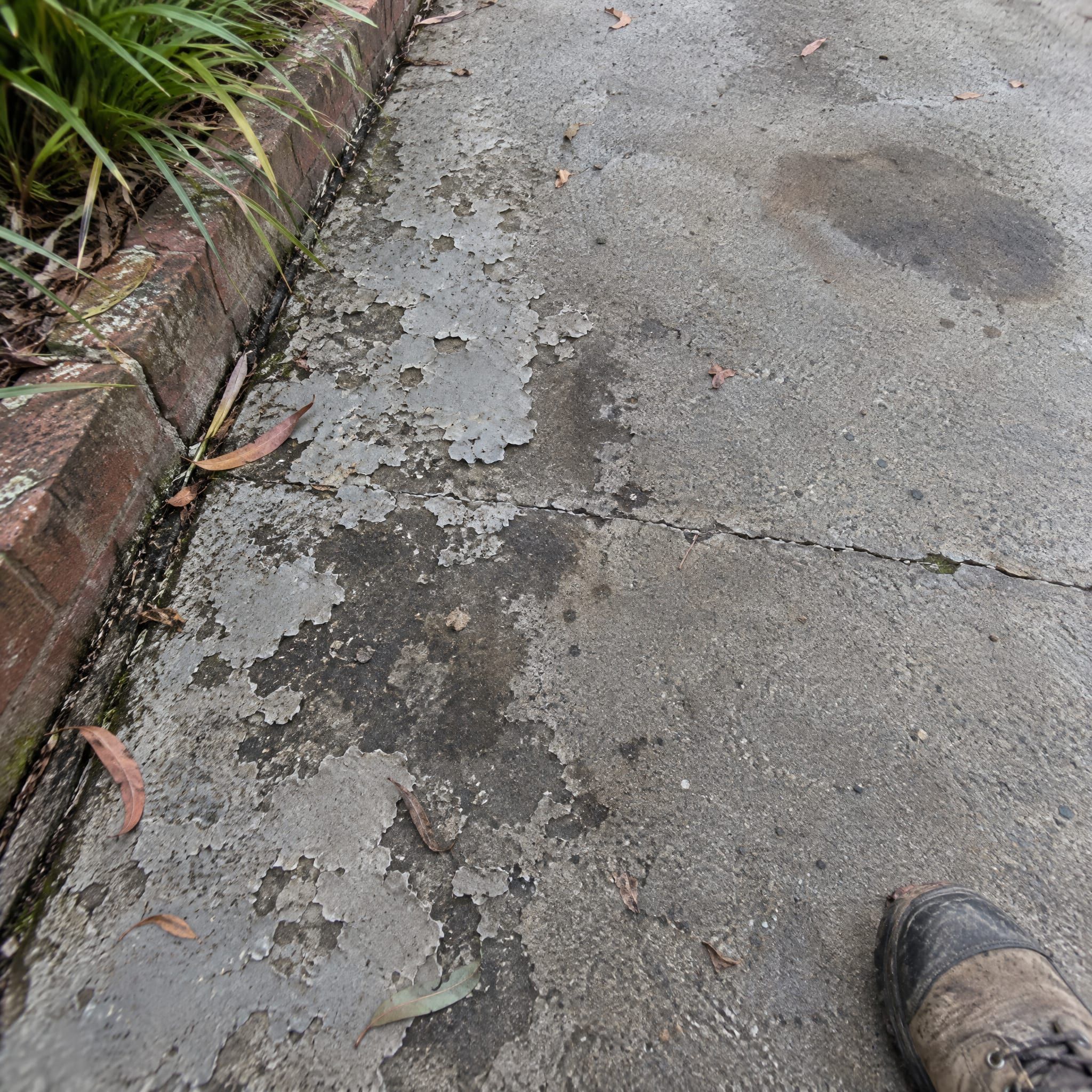
Often, yes, but the cracks decide it. Fine cracks in a slab that has stopped moving can be treated and resurfaced over. Cracks that are widening, stepped or opening and closing with the seasons mean the slab is still moving, and a thin overlay bonded to it will crack in the same places. This guide explains how to read the difference. It is not a crack-filling guide, because treating a crack well depends on knowing why it is there.
What does each type of crack say about the slab?
Most driveway cracks fall into four groups. The first two are usually surface or early-age cracks in a stable slab. The second two are signs of movement.
Hairline and crazing cracks
Fine, shallow cracks, sometimes in a map-like pattern across the surface. They usually form while the concrete cures, the early period when it gains strength and gives up water, because the surface dries and shrinks faster than the concrete below it. They are mostly cosmetic. On a stable slab they are exactly the kind of crack a resurfacing system is designed to cover.
Straight shrinkage cracks
Single, fairly straight cracks running across the slab, often from the corner of a garage or a step, or midway between control joints that are too far apart. A control joint is the groove cut or formed into a slab so that it cracks along a planned line. Concrete keeps shrinking as it dries over its first months, and if the joints do not give it somewhere to crack, it picks its own line.
Many of these cracks stop moving once the slab has finished shrinking. If both sides sit level and the crack has not widened over time, it can usually be treated like a joint and carried through the new surface.
Settlement and heave cracks
Cracks where one side sits higher than the other, sections that have dropped, or cracks noticeably wider at one end. These come from the ground under the slab, the subgrade, settling, washing out or swelling. The slab is following its base. A level surface across a crack is a good sign. A lip you can catch a shoe on is not.
Structural and breaking-up cracks
Cracks that branch across several sections, pieces that rock when a car drives over them, and edges crumbling where wheels run close. These usually mean the slab is too thin for the loads on it, lacks reinforcement where it needs it, or has lost support underneath. The concrete itself is failing.
Width alone does not settle the question, but it helps. The Quote Yard’s NSW resurfacing guide, published April 2026, treats hairline shrinkage cracks as acceptable under an overlay and says movement cracks above 2 millimetres are not, without prior stabilisation. That is a published industry rule of thumb, not a standard. A narrow crack that is still moving is a bigger problem than a wider one that has sat still for years.
How do reactive clay and coastal sand move a slab?
The ground under a driveway moves for two main reasons. Clay soils swell and shrink with moisture. Sandy soils do not swell, but they can be washed out from under the slab.
Reactive clay. A reactive clay soil swells when it gets wet and shrinks as it dries. A driveway on reactive clay rises and falls slightly through the wet and dry seasons, and more at the edges than in the middle, because the edges wet up and dry out first. Trees draw moisture out of clay and make it shrink further. Leaking pipes, downpipes discharging beside the slab and garden beds watered against the edge make it swell.
The Quote Yard’s South Australian resurfacing guide, published September 2026, describes Adelaide’s reactive clays as the dominant factor in whether a resurfacing job succeeds there. It says an overlay laid over a moving crack will re-crack at that location within one to two seasonal cycles. Adelaide is not the Central Coast, but parts of the regions we work in also sit on clay, and the same behaviour applies wherever it does.
Coastal sand. Closer to the water, many driveways sit on sand. Sand drains well and does not swell, but water running along or under the edge of a slab can carry it away. The result is a void under the concrete, a section that drops, or an edge that snaps off when a wheel runs over concrete with nothing beneath it. Washout usually traces back to a downpipe, a blocked drain or runoff from higher ground.
In both cases the slab is responding to something happening below it. Coating the surface does not change the cause. Fixing the drainage or the support often has to come before any decision about the finish.
Which soil sits under your driveway is a site question, not a suburb question. We look at the crack pattern, the levels, the drainage and what sits beside the slab. Where the evidence points to significant ground movement or a structural question, the scope says that engineering advice is needed before work continues.
Why do overlays fail on moving slabs?
Because an overlay has no strength of its own. A resurfacing overlay is a thin cement-based layer bonded to the surface of the slab, the substrate. It is designed to grip that surface, not to hold it together. When the slab moves, the overlay moves with it, and the crack reappears in the new surface along the old line. This is called reflective cracking, or telegraphing.
The Quote Yard’s NSW guide says a cracked or lifting slab will telegraph straight through a new topping within a season or two. Dulux Avista, which manufactures resurfacing products, says the condition of the concrete determines how long resurfacing lasts. Two different sources make the same point. The slab decides.
Peeling is a related failure with a different cause. When resurfacing lifts in sheets rather than cracking in lines, the problem is usually the bond. Moisture coming up through the slab, contamination or old sealer left on the surface, or a painted layer underneath that let go will all release an overlay. That is why preparation, including cleaning as a preparation step and removing coatings that are no longer holding, sits inside the scope rather than being treated as an extra.
How are cracks dealt with before resurfacing?
Each crack is treated according to what it is. That is a decision for the inspection, and the quote should say which approach applies to which crack.
- Hairline and crazing cracks in a stable slab are typically covered by the overlay system after preparation.
- Stable shrinkage cracks are repaired with a compatible material and often treated as a joint, so the overlay is not asked to bridge them.
- Control joints are kept. An overlay laid continuously across a working joint will crack along it, so joints are carried through the new surface.
- Active cracks that move slightly with the seasons can sometimes be isolated. The Quote Yard’s SA guide describes a flexible crack isolation membrane for active cracks. Isolation manages small, seasonal movement. It does not stop a slab that is settling or heaving.
- Settlement, heave and structural cracks are not resurfacing candidates until the cause is dealt with. That usually means drainage work, section replacement or a new slab.
Is sealing enough on its own?
Sometimes, on a stable slab. If the concrete is sound but the surface is porous, stained or dull, preparation and a new sealer may be the right pathway rather than an overlay.
Sealing protects the surface. It does not close cracks, and it will not hide them. Dulux Avista recommends resealing driveways about every two years, sooner under heavy traffic, and describes a surface that looks faded and patchy when dry and darkens when wet as a sign it is due. That is general guidance for driveways rather than a fixed rule, and shade and coastal exposure change it.
Our concrete restoration and sealing service covers repairs, preparation and sealing for slabs that do not need a new surface.
When is replacement the honest answer?
When the slab, or the ground under it, is the problem. Replacement is the honest answer when:
- Sections have sunk or lifted enough to leave lips, steps or ponding
- Cracks are wide, branching or still opening year to year
- Edges are breaking away under wheels
- Tree roots are lifting the slab
- The falls send water toward the garage or house
- Earlier patches and coatings have failed repeatedly in the same places
Replacement can be partial. Where a few sections between joints have failed and the rest are stable, those sections can be cut out and repoured, and the whole driveway resurfaced afterwards for one even finish. The new concrete has to cure first. Cure and moisture readiness before coating is one of our hold points, a recorded check that must pass before the next stage begins.
Where full replacement is right, our concrete design and installation service covers the base, reinforcement, joints, drainage and finish under one scope. If you are still weighing up the options, our guide to resurfacing, painting or replacing a driveway compares all three.
What does the inspection check?
The inspection looks at the slab as a whole, not just the cracks you can see from the letterbox.
- Crack type, width and pattern, photographed and located on the slab
- Lips, steps and level changes across cracks and joints
- Drainage, falls and where the water comes from
- Edges, joints and previous repairs
- Trees, garden beds and downpipes beside the slab
- Existing sealers, paint or coatings, and how well they are holding
The findings go into the scope with the pathway they support. That may be sealing, resurfacing, replacing sections or a new slab. If something concealed turns up once work begins, we stop, photograph it and send a written variation. Nothing proceeds without your approval.
Get the slab assessed
A crack you can see is half the information. The other half is whether it is still moving, and why. We inspect the driveway, photograph what we find and explain which pathway the condition supports before any price is discussed. The inspection is free, across the Central Coast, Lake Macquarie, Newcastle and Sydney.
Request an inspection, or read about concrete restoration and sealing, which covers crack repairs and sealing on stable slabs. If your slab is stable and ready for a new finish, concrete resurfacing and protective coatings is the next step.
Sources
- Concrete Resurfacing NSW 2026 - Pricing Guide - The Quote Yard
- Concrete Resurfacing SA 2026 - Costs, Overlay Types, When It Works, and When to Replace Instead - The Quote Yard
- How Long Does A Resurfaced Driveway Last? - Dulux Avista
- How often should I reseal my driveway? - Dulux Avista
Figures quoted from third-party sources are theirs, as published at the time of writing. They are general information, not a quote or a statement about SOAKD Roof & Concrete's work.