
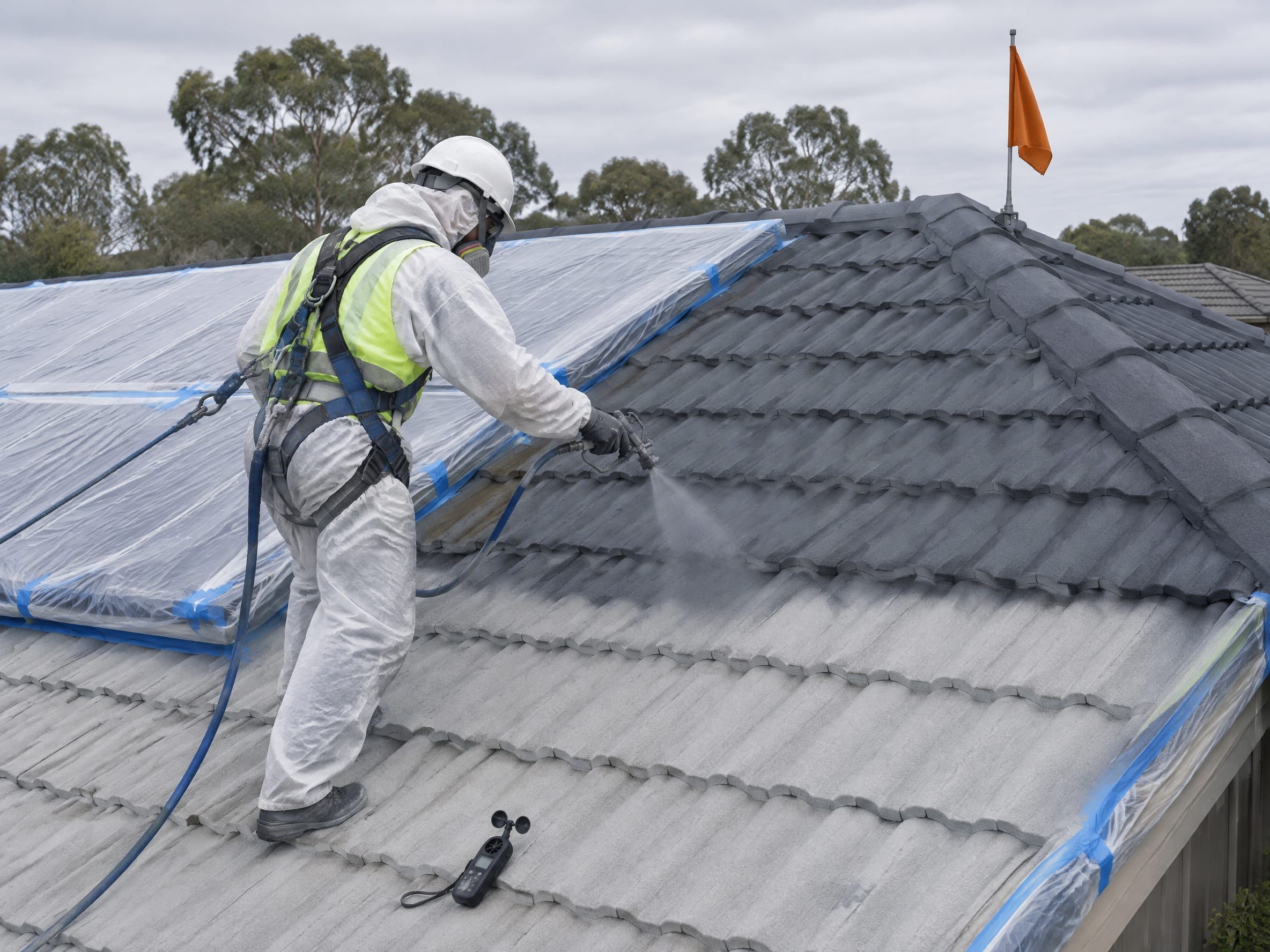
When roof painting is the right job
Roof painting suits a roof that is sound but whose finish has worn out. The tiles or sheets are intact, the ridge lines are holding and the roof is not leaking. It needs a new protective coat, not repairs.
The usual signs are a faded or chalky surface, coating worn through to bare tile, unglazed concrete tiles that have turned porous and stay dark long after rain, or a metal roof whose factory finish has dulled and chalked.
If it needs repairs, it is a restoration
Painting is not a repair. If the inspection finds broken tiles, cracked bedding, failed pointing, lifted flashings or rust through a sheet, those are fixed before any coating goes on, and the job becomes a roof restoration.
That is not an upsell. A coat of paint over a cracked tile or a failed ridge line looks finished for a season and leaves the leak where it was. We will not paint over a defect, and the quote will say which pathway your roof’s condition supports.
The reverse also holds. If the finish is fine but one area is leaking, you do not need a new coat at all. You need a roof repair.
Painting, spraying, respraying and recoating
These are four names for the same job. “Roof painting”, “roof spraying”, “roof respray” and “recoating” all describe a new coating system applied to an existing roof. Spraying is simply the most common way the coating goes on, and a respray or recoat usually means the roof has been coated before.
The name matters less than three questions. Is the roof sound? Is the preparation right? Is the new system compatible with the surface underneath?
How tile and metal roofs are prepared
Preparation decides how well the coating bonds, and it is different for each roof.
- Concrete tiles are porous. Growth and loose, chalky material are removed so the sealer binds to the tile, not to the dust sitting on it.
- Terracotta tiles that are unglazed can be coated in some cases. Glazed terracotta is generally not coated, and we will tell you if yours should be left as it is.
- Metal and COLORBOND® roofs need chalking removed, surface rust treated and fixings checked. Loose fixings or rust through a sheet are repairs, so the job is scoped as a restoration.
Roof cleaning is part of this preparation, not a separate service. The roof is cleaned so the coating bonds to the substrate, the tile or sheet itself, rather than to what is growing on it. While the roof is being prepared we also check the accessible areas and photograph anything that has changed since the inspection.
After cleaning, the surface has to dry before primer goes on. Coating over a damp tile traps moisture and weakens the bond. We check dryness and record it. That check is a hold point, a stage the job does not pass until the check is done.
Primer, sealer and topcoat: why compatibility matters
A coating system is only as good as its first layer. The primer or sealer, the base coat that binds the surface and gives the topcoat something to grip, has to suit both the roof material and any coating already on it.
Getting this wrong is a common reason a recoat peels. A topcoat applied over an incompatible old coating, or over bare metal without the right primer, can lift away no matter how good it looked on the day.
So the quote names the system. That means the primer or sealer, the topcoat and the number of coats, applied to the manufacturer’s specification. If two quotes for the same roof list different systems, ask each one why.
Choosing a roof colour
Choose the system first and the colour second. Most systems come in a range of colours, and the choice affects more than looks.
- Heat. Lighter colours generally reflect more of the sun’s heat than darker ones.
- Weathering. Dust, fading and growth show differently on light and dark roofs.
- Rules. Some estates, strata schemes and heritage areas restrict roof colours. Check with your council or owners corporation before you settle on one.
- Light. Look at a sample outdoors, in daylight, against your walls and gutters. Screens and small printed chips are misleading.
Shortlist colours on our roof paint colour chart or the COLORBOND® colour chart, and see what each layer of the system does on the Shieldcoat systems page.
Heat reflective roof coatings
A heat reflective roof coating is a topcoat formulated to reflect more of the sun’s energy than a standard finish of the same colour. It is designed to reduce the heat the roof surface absorbs. How much difference you notice inside depends on the house, including the insulation, the roof ventilation and the colour you choose.
We do not quote temperature reductions as our own. Manufacturers publish test information for their products, and we will show you the published information for any system we propose so you can read it yourself. Our guide on what decides how long a roof coating lasts covers where heat reflective options fit in a system.
We protect before we spray
Overspray is the largest risk on a roof painting job. Fine coating mist carries on the wind onto cars, windows, pools, solar panels, rendered walls and the neighbours’ property.
The rule is simple. If overspray cannot be adequately controlled, we do not spray. On each coating day we check the wind and the weather against what sits around the roof. If the answer is no, we tell you why and reschedule. The coating date follows the conditions, not the other way round.
Masking covers solar panels, skylights, windows, flues and vents, gutters that are not being coated, cars, paving and gardens. Exclusion zones keep people clear of the work while spraying is under way.
What affects roof painting cost
The cost of painting a roof follows the roof, not a rate card. The main factors are size and pitch, height and access, the roof material, how much preparation the surface needs, the system and number of coats, and how much masking the site calls for. Solar panels, a tight block or neighbours close to the roof all add protection work.
That is also why quotes vary. A lower number can leave out the primer, the masking or the dryness check. Ask every quote to name those items.
What your roof painting quote will name
If you are comparing roof painters, the quote is where the differences show. Ours states:
- The condition we found, with photographs, and why the roof suits painting rather than restoration
- The preparation, including how the roof is cleaned and how growth is treated
- The primer or sealer and the topcoat, by name, with the number of coats
- The colour, and whether it is a heat reflective finish
- What is masked or removed, including any solar panels, and who is responsible for each step
- What is excluded
- The completion documentation you receive
If preparation uncovers something the inspection could not see, such as a cracked tile under growth, we stop, photograph it and send a written variation. Nothing proceeds without your approval. At the end you receive before, during and after photographs, the hold-point records and the system installed.
Book a free roof inspection
The inspection is free. We look at the roof, photograph it and tell you whether painting is the right job before any price is discussed. Request an inspection or call 0468 029 068. We paint roofs across the Central Coast, Lake Macquarie, Newcastle and Sydney.
The SOAKD Pathway
How this job runs, start to finish
- 01 Diagnose
- 02 Decide
- 03 Deliver
- 04 Defend
- 05 Document