
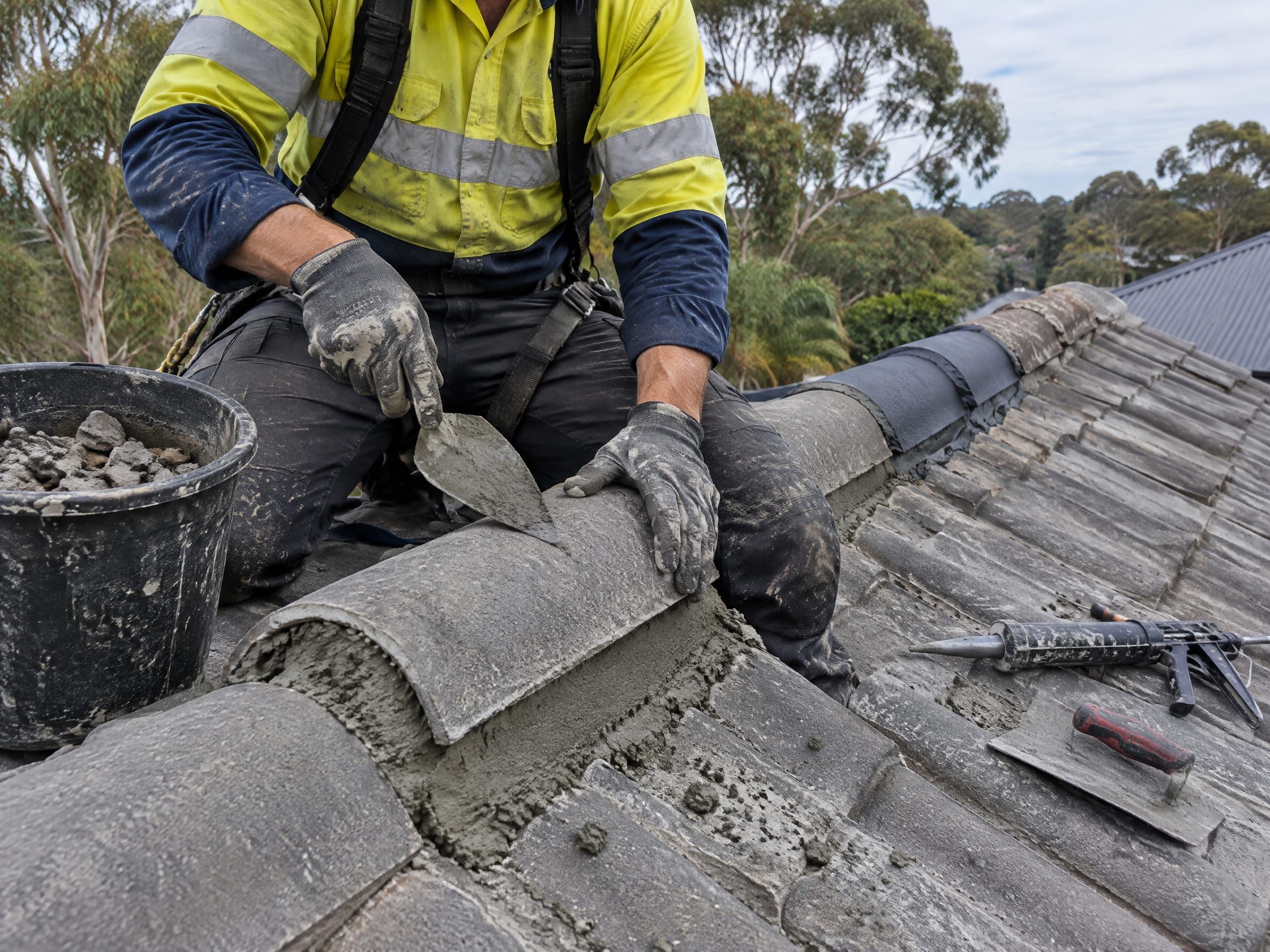
What roof repairs cover
A roof repair fixes a specific failure in a roof that is otherwise sound. Most repairs fall into a handful of types:
- Leaks traced to a cracked tile, a ridge joint, a flashing, a valley or a penetration
- Slipped, cracked or broken tiles
- Ridge and hip caps that need rebedding, repointing or both
- Lifted, rusted or poorly sealed flashings
- Valleys that are rusted, blocked or overflowing
- Loose, corroded or failed fixings on metal roofs
Each one is found, photographed and repaired at the cause. Then we tell you whether the rest of the roof is in the same condition.
Roof leak repair starts on the roof, not the ceiling
The stain on your ceiling shows where the water landed, not where it got in. Water enters at one point, then runs along the underside of the tiles, the battens (the timber or steel strips the tiles hang on), the sarking (the membrane laid under the tiles) or the frame before it drips.
So a leaking roof is diagnosed from above. We work back from the stain, check the likely entry points upslope and around it, and repair the one that is letting water in. Patching the tile directly above the stain often leaves the real entry point untouched.
Our guide on why a roof leaks and whether it needs a repair or a restoration explains the common entry points on tile and metal roofs. If water is coming in right now after a storm, go to emergency roof repairs.
Roof tile repair: slipped tiles and broken tiles
A slipped tile and a broken tile are different problems with different causes.
- A slipped tile has moved out of position. Wind, foot traffic, a failed fixing or a tile that never sat properly can all move it. Putting it back is straightforward. The useful question is why it moved, because the same cause will move it again.
- A broken or cracked tile has failed. Impact, hail, foot traffic and age are the usual causes. It is replaced where a suitable replacement tile is available.
On older roofs a matching tile is not always available. Profiles change and colours weather. Where a close match cannot be found, we tell you before the repair and set out the options.
Rebedding and repointing: bedding versus pointing
Ridge and hip caps, the curved tiles that cover the peaks and hips of a tile roof, are held by two layers. Bedding is the mortar bed the caps sit on. Pointing is the flexible compound laid over the bedding that seals the joint and lets the roof move without cracking it.
They fail in different ways, so they are repaired in different ways.
| What you see | What it usually means | The repair |
|---|---|---|
| Fine cracks or gaps in the pointing, caps firm | The pointing has failed, the bedding is sound | Repointing |
| Caps that rock or move, crumbling mortar underneath | The bedding has failed | Rebedding, then repointing |
| Caps missing or displaced | The bedding has failed, possibly the fixings too | Rebedding, refixing and repointing |
Repointing over failed bedding produces a neat line sealing caps that nothing is holding. If the bed has gone, the caps come off, a new bed is laid, the caps are refixed and then pointed. The quote states which repair each ridge needs, by length, with photographs. Our rebedding vs repointing guide shows how to tell the two apart on a quote.
Flashings, valleys and penetrations
Most leaks start where the roof meets something else. These junctions carry more water than the open field of tiles, and they are the first places we check.
- Flashings are the metal or flexible strips that seal the joint where the roof meets a wall, a chimney, a skylight or another roof. They lift, rust, crack or lose the sealant that holds them.
- Valleys are the channels where two roof slopes meet. They collect leaves and silt, overflow in heavy rain, and older valley irons rust through.
- Penetrations are anything that passes through the roof, such as vents, flues, skylights, antennas and solar mounting. The seal around each one ages and fails.
The repair might be resealing, refixing, replacing a section of flashing or replacing a valley iron. The quote names which, and where.
Metal roof repairs
On a metal roof the weak points are the fixings, the laps and the edges. Screws loosen and their sealing washers perish. Laps, where one sheet overlaps the next, let water track in. Cut edges and fixings corrode first, especially close to the coast.
Repairs replace failed fixings, reseal laps and penetrations, and treat surface rust. A sheet that has rusted through is replaced, not patched. Where rust is across most of the roof, replacing one sheet does not change the outcome, and we will say so.
When a repair is enough, and when it is a symptom
A repair is enough when the problem is in one place and the rest of the roof is sound. It is a symptom when the same failure shows up across the roof.
Signs a repair is treating a symptom:
- Pointing cracked along every ridge, not just one
- Tiles breaking in several places, or crumbling underfoot
- Leaks that return in different spots after each repair
- Corrosion on most sheets, not one
- A roof line that sags, or battens that have rotted
On a roof like that, repairs keep it going but do not change its condition. The honest pathway is usually roof restoration when the tiles or sheets are sound, or roof replacement when they are not. We will tell you which, with the photographs that show why, and still quote the repair if that is what you want to do for now.
Periodic roof maintenance checks
A maintenance check is a planned look at the roof before a small failure becomes a leak. We check the accessible areas, including tiles, ridge lines, valleys, flashings and penetrations, photograph them and note anything that has moved or failed since the last visit.
For strata and property managers, checks can be scheduled across several properties, with a report for each one written so it can go straight into an owner or committee file.
What your repair quote will name
A repair quote should name each repair, where it is and why it is needed. Ours states:
- Each repair by location, with the photograph that shows it
- Quantities where they can be measured, such as metres of ridge or number of tiles
- The cause we found, not only the symptom
- What is excluded, and what the repair does not address elsewhere on the roof
- What happens if a concealed condition is found once work starts
If we find something we could not see at inspection, we stop, photograph it and send a written variation. Nothing proceeds without your approval. You receive before and after photographs of every repair.
The inspection is free. Request an inspection or call 0468 029 068.
The SOAKD Pathway
How this job runs, start to finish
- 01 Diagnose
- 02 Decide
- 03 Deliver
- 04 Defend
- 05 Document