
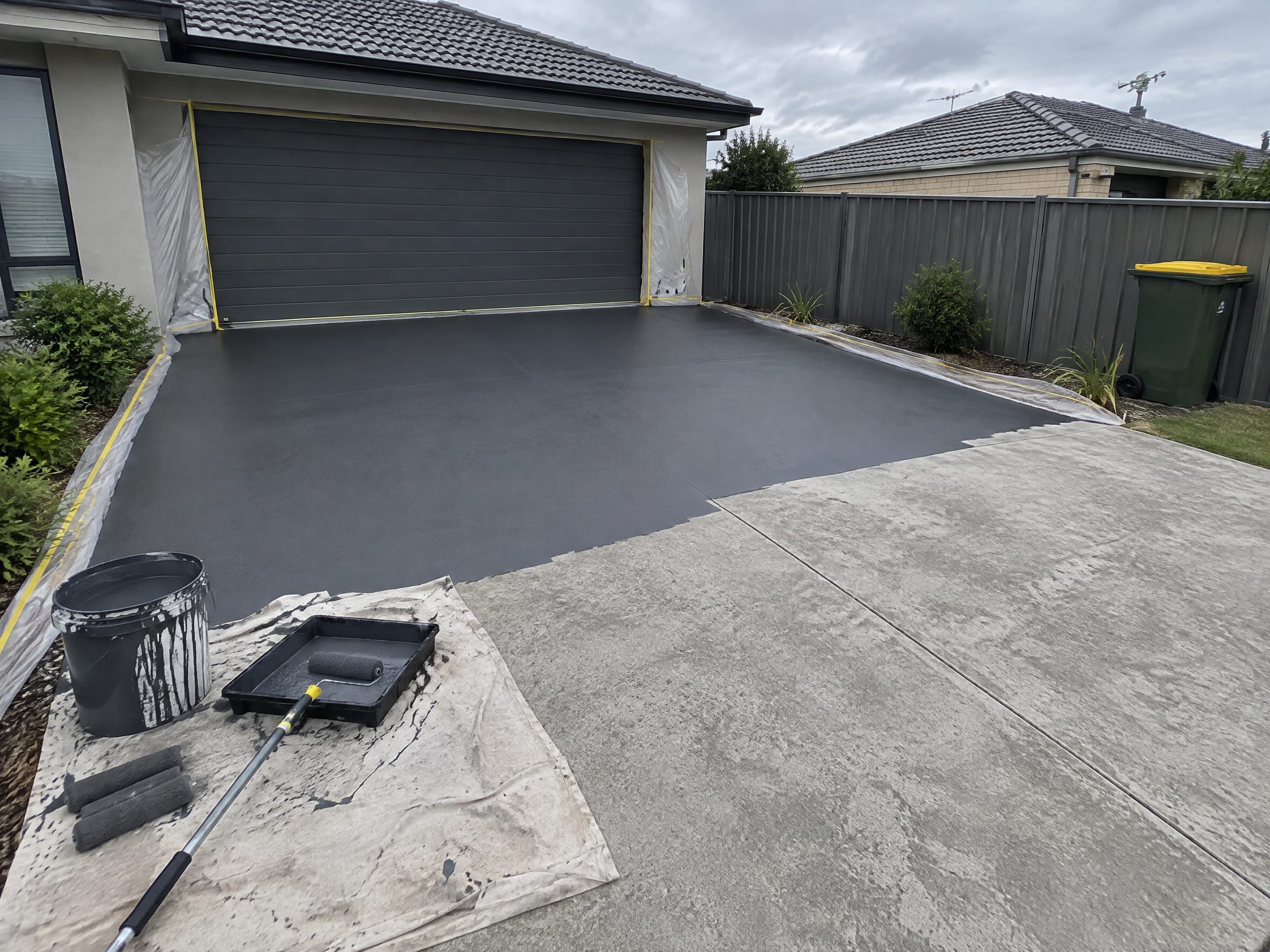
What concrete resurfacing actually is
Concrete resurfacing puts a new wearing surface over an existing slab that is still sound. It changes how a driveway, path or patio looks and wears without breaking it out and pouring again. It does not fix a slab that is broken, sinking or still moving.
The word gets used loosely. Some quotes call a coat of paint “resurfacing”. Ours do not. Every quote names the actual system, and a painted surface is never sold as a resurfacing overlay.
What is the difference between an overlay, paint and a sealer?
They are three different products that do three different jobs. Each has a place, and the condition of the slab decides which one fits.
| System | What it is | What it does | Where it fits |
|---|---|---|---|
| Resurfacing overlay | A thin cement-based layer with a resin added, applied by spray, trowel or squeegee, then sealed | Gives a worn or stained slab a new surface with its own texture and colour | Sound slabs with surface wear, staining, light scaling or patchy old repairs |
| Paint or colour coat | A thin coating that forms a film on the surface | Changes the colour. It does not rebuild or level the surface | Sound, well-prepared slabs where a colour change is the goal |
| Sealer | A clear or tinted coat that soaks in or forms a film | Protects against staining and water, and can deepen the colour | New slabs, exposed aggregate and restored concrete |
An overlay is the substantial option. “Spray-on concrete” is one form of it: a cementitious coating, meaning cement-based, applied in a layer thick enough to carry texture. A paint is a film, and it behaves like one. If the surface under it is damp, dusty or contaminated, it lifts.
A concrete coating of any kind is only as good as the slab and the preparation beneath it. Our guide to resurfacing, painting or replacing a driveway walks through the same decision.
Can a cracked driveway be resurfaced?
Sometimes. It depends on the type of crack, not just how many there are.
- Hairline shrinkage cracks - fine surface cracks from the concrete drying as it cured. Usually stable, and usually suitable once treated.
- Cracks along control joints - the grooves cut into a slab so it cracks in a straight line. The joint is doing its job, so it is carried through the new surface rather than covered.
- Cracks with a lip or a widening gap - a sign the slab has settled or is still moving. An overlay laid over active movement cracks along the same line.
- Broken or sunken sections - the base underneath has failed. That is a repair or replacement decision, not a resurfacing one.
Where the slab needs repair before it can be coated, that work comes first under concrete restoration. Where it has failed, the honest answer is a new slab, and we quote design and installation instead. Our guide on whether a cracked driveway can be resurfaced explains how each crack is read.
What we diagnose first
Before any recommendation, we look at the slab and photograph it:
- The substrate - the existing concrete the new surface has to bond to. Is it sound, or is the top layer powdery, scaling or breaking away?
- Cracks and joints - their type, width and displacement, and whether they are moving
- Contamination - oil, tyre marks, rust, growth and efflorescence, the white salt deposits that rise through damp concrete
- Existing coatings - old paint or sealer is tested for adhesion or removed. A new system is only as good as the layer it sits on
- Moisture - damp patches, drainage, falls and where water sits after rain
- Use - cars, foot traffic, pool surrounds and slopes all change the system and the slip resistance required
How the surface is prepared
Preparation decides whether a coating holds. It is most of the job, and it is where shortcuts show first.
- Cleaning, as preparation. Oil, growth and loose material are removed so the system bonds to concrete, not to what is on it. Cleaning is a stage of this work, never the service on its own.
- Mechanical preparation. Where the surface needs it, the slab is ground or profiled, roughened so the new layer can key in, and failed coatings are taken off.
- Repairs. Cracks are treated by type, spalled edges (where the surface has flaked or broken away) are rebuilt, and joints are kept as joints.
- Moisture and cure hold point. A hold point is a stage where work stops until a check is passed. Before any coat goes on, we confirm the slab is dry enough and, on newer concrete, cured enough to take it. Cure is the period in which concrete gains strength and gives up its moisture. We record the check.
- Masking and the weather call. Walls, garage doors, windows, cars, gardens, fences and the neighbours’ surfaces are masked. Rain, temperature and wind decide whether the system goes down that day.
- Application and QA. The named system is applied in its stated coats, then checked, photographed and signed off.
Decorative, coloured and slip-resistant finishes
An overlay or coating can change more than the colour.
- Coloured finishes - a single colour, or a base colour with a fleck or second tone for a more natural look
- Decorative finishes - patterns such as borders, tile or stone effects, formed in the overlay rather than painted on
- Slip-resistant finishes - texture in the overlay or an additive in the sealer, for slopes, steps, pool surrounds and paths that are often wet
Slip resistance is a trade-off. More texture grips better and holds more dirt. We talk through where it matters on your site, and the quote states what goes where.
Try a base and two fleck colours in our spraycrete fleck mixer, or see solid colours on the driveway paint colour chart.
We protect before we spray
Overspray from a concrete coating lands on render, garage doors, cars, pool fences and the house next door, and some of it does not come off.
If overspray cannot be adequately controlled, we do not spray. Where wind or a tight site rules it out, the system is applied by roller or trowel where it allows, or the day moves. Either way, we tell you why.
What your quote will name
- The condition found, with photographs
- What is included and what is excluded
- The preparation method and the repairs, by location
- The system by type and name, and the number of coats
- The colour, the finish and any slip-resistant texture or additive
- The moisture and cure check, and what happens if the slab does not pass it
- How the site is protected, and when foot traffic and cars can return
- The completion documentation you receive
If something concealed turns up once work begins, we stop, photograph it and send a written variation. Nothing proceeds without your approval.
Evidence, not assurances
Every job closes with a completion record: the condition found, the system applied, the hold-point checks, before, during and after photographs, and the maintenance pathway from here, including what to watch for before the surface needs resealing.
If your driveway is stained, worn or patched and you are not sure which of the three systems it needs, request a free inspection. We will tell you what the slab can take before we talk about finishes.
The SOAKD Pathway
How this job runs, start to finish
- 01 Diagnose
- 02 Decide
- 03 Deliver
- 04 Defend
- 05 Document