
What commercial owners, facility managers and builders need
You are accountable for an asset that has to keep operating. A leak over stock, a roof job that shuts a loading dock, or a hardstand coating that lifts under forklifts lands on you, along with the question of why it was not picked up earlier.
The contractor failures are familiar. A quote that cannot be matched to the asset register. A permanent repair re-scoped halfway through the job. Make-safe photographs the assessor will not accept, because they show the tarp but not the damage under it. Trades who all look the same until one lets you down.
We work to the SOAKD Pathway. Diagnose, decide, deliver, defend, document. The scope is written before the price, the system is named and every hold point, a stage where work stops until a check is passed, is recorded.
Metal roofs on warehouses, factories and retail
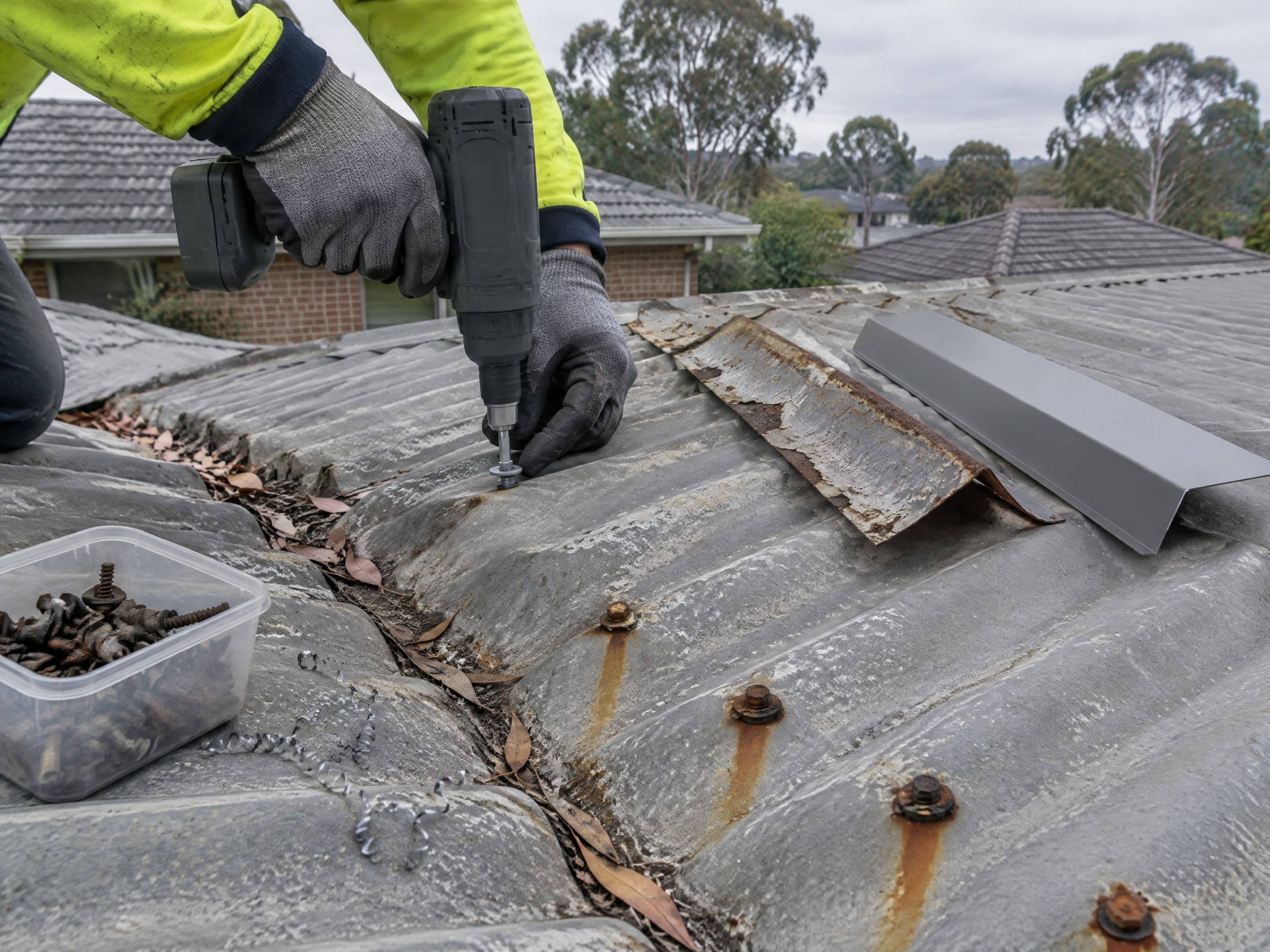
Most commercial roofs are metal, and most commercial roof leaks start in the same places. Fixings, laps where sheets overlap, flashings (the strips that seal joints and edges), penetrations, and box gutters, the gutters built into the roof rather than hung on its edge. We inspect and photograph each of those before recommending anything.
- Repair suits a sound roof with leaks at fixings, flashings or penetrations, or a few corroded sheets. See roof repairs.
- Restoration suits sheets that are sound but whose coating has failed, once corrosion is treated and failed fixings are replaced.
- Replacement is the honest answer when corrosion has gone through the sheets across the roof, or the roof contains asbestos cement sheeting.
We do not remove asbestos ourselves. It is assessed and managed through an appropriately licensed asbestos professional before roof work in that area continues, and we ask for the site’s asbestos register where it has one.
Older commercial roofs also have fragile areas, such as skylights and aged sheeting, that will not take a person’s weight. They are identified and controlled before anyone works near them.
Hardstands, car parks and commercial concrete
A hardstand is a reinforced slab built to carry vehicles, plant or stored goods. When it cracks, sinks or sheds its surface, the cause is usually in the base, the joints or the drainage, not the finish.
We diagnose the slab first. Crack type and movement, joint condition, drainage and falls, oil and chemical contamination, and existing coatings. A sound slab can be repaired, prepared and coated. A failed one is broken out and replaced, with the thickness and reinforcement set for how it is used, engineering advice where the loads call for it and a recorded pre-pour check before any concrete is ordered. Our page on concrete design and installation sets out that sequence.
Each concrete quote names the actual system, and a painted surface is never described as a resurfacing overlay. Coatings wait until the slab passes a moisture and cure check. Cure is the period in which concrete gains strength and gives up its moisture.
Working around an operating business
Work is planned around your operations. Before work starts, we agree with the facility manager:
- The areas to be closed, in what order and for how long
- Access for deliveries, staff, customers and emergency exits
- Exclusion zones under and around roof work
- Coating days and the weather call, with the reason given if a day moves
- Site induction, permits and your own contractor requirements
High-risk work such as work at heights is planned in a SWMS, a safe work method statement, with working-at-heights controls set for the roof. Licensed trades handle electrical, solar, structural and asbestos work.
Overspray matters more on a commercial site, with vehicles, stock, plant and neighbouring tenancies close by. If overspray cannot be adequately controlled, we do not spray.
Staged programs and documentation for the asset register
Large roofs and car parks are often done in stages, to spread the work across financial years or keep part of the site trading. Each stage has its own scope, hold points and completion record.
The completion report is written to be filed. It records the condition found, the pathway chosen, the system installed, the hold-point records, before, during and after photographs, the QA sign-off and the maintenance pathway. That gives the asset register a dated record of what was done to which roof or slab, and what to watch for next.
Make-safe and insurer documentation
For builders and insurance-repair coordinators, the make-safe is the start of the file. A make-safe is the temporary work that reduces hazards and limits water getting in after damage. Where the roof can be accessed safely, we photograph the damage before anything is touched, carry out the make-safe, then photograph the temporary work. The report records the damage, the cause found, the work done, what it does not address and the recommended permanent repair.
We cannot speak for the insurer or the assessor. The report is written so it can go into their file as it stands. The permanent repair is quoted as a scope with inclusions, exclusions and assumptions, so it is not re-scoped halfway through. If a concealed condition appears, we stop, photograph it and send a written variation, and nothing proceeds without approval. Our page on emergency roof repairs covers how a storm call runs.
What to ask any commercial roof or concrete contractor
Put the same questions to every contractor on the shortlist.
- What did you find, and can I see it photographed by location?
- Is this repair, restoration or replacement, and what is the reason?
- What is included, excluded and assumed?
- Which system, by name, and how does it suit the traffic or exposure on this site?
- How will you work around our operations, and what will you need closed?
- What are your SWMS and working-at-heights controls for this roof?
- How do you handle asbestos, fragile roofing and electrical conflicts?
- How are variations raised and approved?
- What documentation do we receive for the asset register or the insurer?
- Can we see your licence and insurance details for this work, so we can check them?
Request a commercial inspection
We work with commercial owners, facility managers and builders across the Central Coast, Lake Macquarie, Newcastle and Sydney. The inspection is free. Request an inspection or call 0468 029 068.