
The short answer
Most roofs fall into one of four tiers. A spot repair fixes an isolated fault. A rebed and repoint renews failed ridge mortar. A full restoration repairs, prepares and recoats a sound roof whose surface has worn out. Replacement is for widespread tile or sheet failure, sagging, rotten battens or asbestos. The symptoms, not the age, decide the tier.
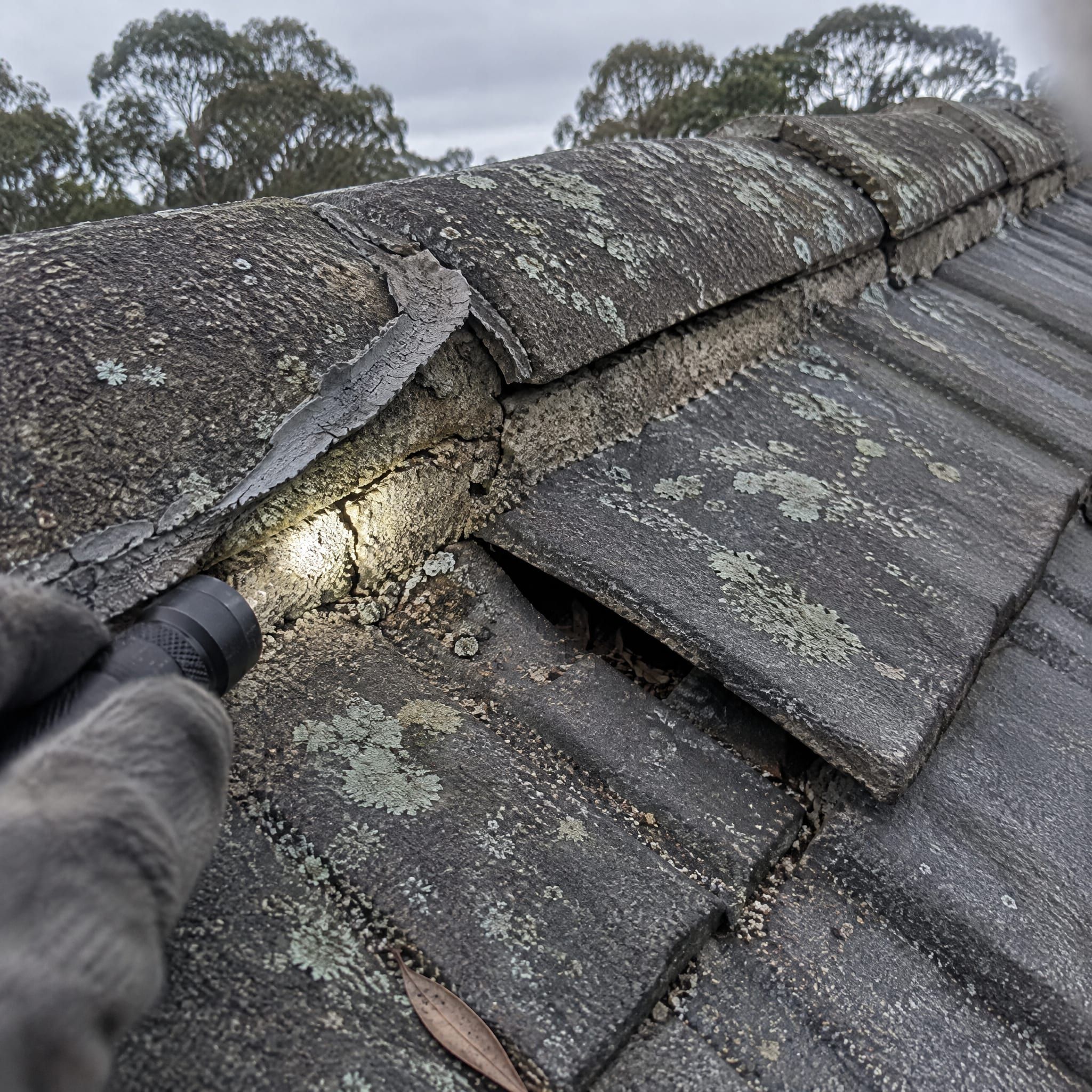
Every roof sits in one of four tiers. It needs a spot repair, a rebed and repoint of the ridges, a full restoration, or replacement. Each tier has symptoms you can see, and most of them show from the ground, the gutter line or the roof space. Knowing which tier your roof is likely in before the quotes arrive lets you check whether each quote is answering the right question.
Why three quotes can give you three different answers
Quotes differ because they often answer different questions. One roofer prices a repair, another a restoration, a third a replacement, and none of them writes down what condition they found.
That leaves you comparing prices for three different jobs. The fix is to ask every quote to name the tier, show the photographs that support it, and list the repairs by location and quantity. Once the diagnosis is on paper, the quotes can be compared on the same basis.
This guide sets out the four tiers and the symptoms that place a roof in each. It is the same decision we work through on every roof before a price is discussed.
What a roof inspection is actually checking
A roof inspection checks the parts of the roof where water gets in and where structure fails. On a tile roof that means:
- Tiles. Cracked, broken, slipped or porous tiles, and the reason a tile has moved.
- Bedding. The mortar bed that holds the ridge and hip caps, the rounded tiles along the top and the sloping corners of the roof.
- Pointing. The flexible compound laid over the bedding to seal the joint.
- Valleys. The channels where two roof slopes meet and water concentrates.
- Flashings. The metal strips that seal the roof where it meets walls, chimneys, skylights and vents.
- The roof space, where it can be reached. Water staining on the sarking, the reflective membrane under the tiles that catches water that gets past them, and on the battens, the timber or steel strips the tiles hang on.
On a metal or COLORBOND® roof the list changes to fixings, corrosion, laps where sheets overlap, flashings and sealant at penetrations.
The age of the house tells you very little on its own. Two roofs built in the same year on the same street can sit in different tiers because of orientation, shade, trees, coastal exposure and how they have been maintained.
The four tiers at a glance
| Tier | What it fixes | Typical symptoms |
|---|---|---|
| Spot repair | One isolated fault on a sound roof | A few cracked or slipped tiles, one lifted flashing, one leak with a clear cause |
| Rebed and repoint | Failed ridge and hip mortar | Loose or misaligned caps, crumbling mortar, cracked pointing along several ridges |
| Full restoration | A sound roof whose surface and ridge lines have worn out | Porous or faded tiles, widespread lichen, failed pointing on most ridges, small faults spread across the roof |
| Replacement | A roof that has failed structurally or contains asbestos | Widespread tile failure, sagging, rotten battens, metal rusted through, leaks despite an earlier restoration |
Symptoms that mean a spot repair is enough
A spot repair is enough when one fault has a clear cause and the rest of the roof is sound. The test is the rest of the roof, not the size of the stain on the ceiling.
Symptoms that usually point to a spot repair:
- A few cracked or slipped tiles, often after foot traffic from another trade, a fallen branch or an antenna installation
- One leak traced to a single cause, such as a lifted flashing, a blocked valley or a cracked tile
- A short run of cracked pointing on one ridge, with the caps still firm in their bed
- On a metal roof, a few loose or corroded screws, or a failed seal around one vent pipe
What’s The Damage’s national leak repair guide, updated November 2026, draws the same line. A single leak with an identified cause is a repair, while repeated leaks in new spots suggest the roof surface itself is ageing.
If you are dealing with a leak right now, our guide on why roofs leak and whether it needs a repair or a restoration explains how the source is traced. Isolated faults are scoped and photographed as roof repairs.
Symptoms that mean a rebed and repoint
A rebed and repoint is the right tier when the ridge and hip lines have failed but the tiles across the roof are still sound.
Symptoms that point here:
- Ridge or hip caps that are loose, rock when pressed or have moved out of line
- Mortar that is cracked, crumbling or falling out, sometimes found in pieces in the gutters
- Gaps under the caps, or daylight visible along the ridge from the roof space
- Cracked or lifting pointing along several ridges rather than one short run
The detail that matters is which layer has failed. If only the pointing has cracked and the bedding underneath is still holding the caps, a repoint can be enough. If the bedding has failed, the caps must be lifted and rebedded before new pointing goes on. Our guide on rebedding vs repointing explains how to tell the two apart.
Ridge work can stand alone, or it can be the first stage of a restoration. That depends on the condition of the rest of the roof.
Symptoms that mean a full restoration
A full restoration suits a roof whose tiles or sheets are structurally sound but whose surface, pointing or coating has failed across the roof. The structure is worth keeping. The surface is not doing its job.
Symptoms that point to restoration:
- Concrete tiles that have lost their surface coating and look faded, chalky or porous
- Moss and lichen across large areas of the roof, which hold moisture against the tile surface
- Failed pointing on most ridges, not just one
- Several small faults spread across the roof rather than one isolated problem
- On a metal roof, faded coating and surface rust on sheets that are still sound, with fixings starting to corrode
A restoration is a sequence. The roof is repaired first, then cleaned as preparation, dried, primed and coated with a named system. Coating over a cracked tile or a failed ridge hides the problem for a season and leaves the leak where it was. Our roof restoration page sets out each stage.
Glazed terracotta tiles are a separate case. Restoration on those roofs generally focuses on repairs, rebedding and repointing rather than coating.
Symptoms that mean replacement
Replacement is the honest answer when the roof has failed structurally, when the failure is too widespread to repair, or when the roof contains asbestos. A coating does not add strength, so it cannot fix any of these.
Symptoms that point to replacement:
- Tiles failing across the roof, not in patches. What’s The Damage’s restoration vs replacement guide, updated November 2026, suggests replacement is usually the better investment when more than 30 per cent of tiles are cracked, broken or missing.
- A sagging roof line, or battens and framing that are rotten or failing
- Metal sheets rusted through rather than marked with surface rust
- Leaks that continue despite an earlier restoration
- Asbestos cement sheets or tiles, which the same guide lists as a replacement case requiring licensed removal
A roof that contains asbestos is not cleaned and coated. It is a replacement conversation from the start.
Replacement has its own hold point, a check that must be passed before the next stage starts. Structural defects, asbestos, electrical or solar conflicts and concealed conditions found after strip-off are documented and managed through the licensed trade, engineering advice or a written variation before work continues. Our roof replacement page explains the process.
What public cost guides say about each tier
Published cost ranges are wide, they are written for Sydney or NSW in general, and none of them can price your roof. They are useful for one thing, which is seeing how far apart the tiers sit.
| Tier | Published range | Source |
|---|---|---|
| Spot repair | Minor roof repair $290-$920 | What’s The Damage, Sydney roof repair guide, updated November 2026 |
| Spot repair | Minor leak repair $200-$500 | The Quote Yard, NSW roof repair cost, published September 2026 |
| Rebed and repoint | Full rebedding and repointing $920-$4,025 | What’s The Damage, Sydney roof restoration guide, updated November 2026 |
| Rebed and repoint | Repointing $40-$80 per metre, rebedding $80-$120 per linear metre | The Quote Yard, NSW rebedding cost, published January 2026 |
| Full restoration | Tile roofs $4,600-$12,650, metal roofs $4,025-$11,500 | What’s The Damage, Sydney roof restoration guide, updated November 2026 |
| Full restoration | From around $2,500 up to $20,000 and beyond | Canstar, citing hipages estimates, July 2026 |
| Replacement | Full replacement of a single-storey home $16,100-$34,500 | What’s The Damage, Sydney roofing cost guide, updated November 2026 |
What’s The Damage notes that its restoration figures include GST and are based on a standard single-storey home. All of these figures come from cost guides and aggregators, not from independent testing, and they are not our prices. Your roof’s size, pitch, height, access, the repairs found and whether solar panels are fitted will move the number in either direction.
The pattern is the useful part. Each tier up costs more because it does more. When two quotes for the same tier are far apart, the scope usually explains why.
Solar panels and strata change the answer
Solar panels and strata ownership do not change the condition of the roof. They change how the work is planned and who decides.
Solar panels. Panels have to be masked in place or temporarily removed and reinstalled by a licensed electrician, depending on the system and the access needed. Canstar’s roof restoration cost guide notes that solar panels are likely to make a restoration more complex and increase the cost. If panels are still being planned, it can make sense to deal with the roof first. Our guide on restoring a roof with solar panels covers that decision.
Strata. In a strata scheme the roof is often common property, so the decision and the cost usually sit with the owners corporation rather than one owner. If you are in strata, talk to your strata manager first. A written scope that names the tier, the evidence and the inclusions gives the committee something it can compare across quotes.
What to ask every quote to include
Whichever tier your roof is in, a quote you can rely on states:
- The tier it is quoting for, and the photographs that support it
- The repairs, by location and quantity where they can be measured
- What is included and what is excluded
- The assumptions made about the roof, and what happens if a concealed condition is found after work starts
- For a restoration, the preparation steps, the dryness check and the primer and coating system by name
- For a replacement, the roofing material, how the old roof is removed and what happens if asbestos or structural defects are found
- How the site, solar panels and neighbouring properties will be protected
- The completion documentation you receive
If something concealed turns up once we start, we stop, photograph it and send you a written variation. Nothing proceeds without your approval.
If you are comparing restoration quotes, our guide on what determines how long a roof restoration lasts shows how to compare them on the factors that decide the result.
Get the condition checked
The inspection is free. Daniel, our director, leads roof diagnosis and quoting. We inspect the accessible areas of your roof, photograph what we find and tell you which tier the condition supports before any price is discussed. If the roof is past restoring, we say so and quote the replacement instead.
Request a free inspection or call 0468 029 068. To see how the work is sequenced once the tier is clear, read our roof restoration page. We work across the Central Coast, Lake Macquarie, Newcastle and Sydney.
Sources
- Roof Restoration Cost Sydney 2026 - What's The Damage
- Roofing Cost Sydney - What's The Damage
- Roof Repair Cost Sydney - What's The Damage
- Roof Replacement vs Restoration: Which Do You Need and What Does It Cost? - What's The Damage
- Roof Leak Repair Costs: Finding and Fixing the Drip - What's The Damage
- Roof restoration cost - Canstar
- Roof Rebedding Cost 2026 NSW - The Quote Yard
- Roof Repair Cost 2026 NSW - The Quote Yard
Figures quoted from third-party sources are theirs, as published at the time of writing. They are general information, not a quote or a statement about SOAKD Roof & Concrete's work.