
What concrete restoration involves
Concrete restoration brings an existing slab back without replacing it. The slab is prepared, repaired, recoloured where suitable and sealed, in that order. It suits concrete that is structurally sound but stained, cracked, patchy or carrying a sealer that has failed.
It sits between doing nothing and a new surface. If the slab needs a new wearing layer, that is concrete resurfacing. If it has broken up or is still moving, it needs a new slab, and we will say so.
Why does “clean and seal” fail?
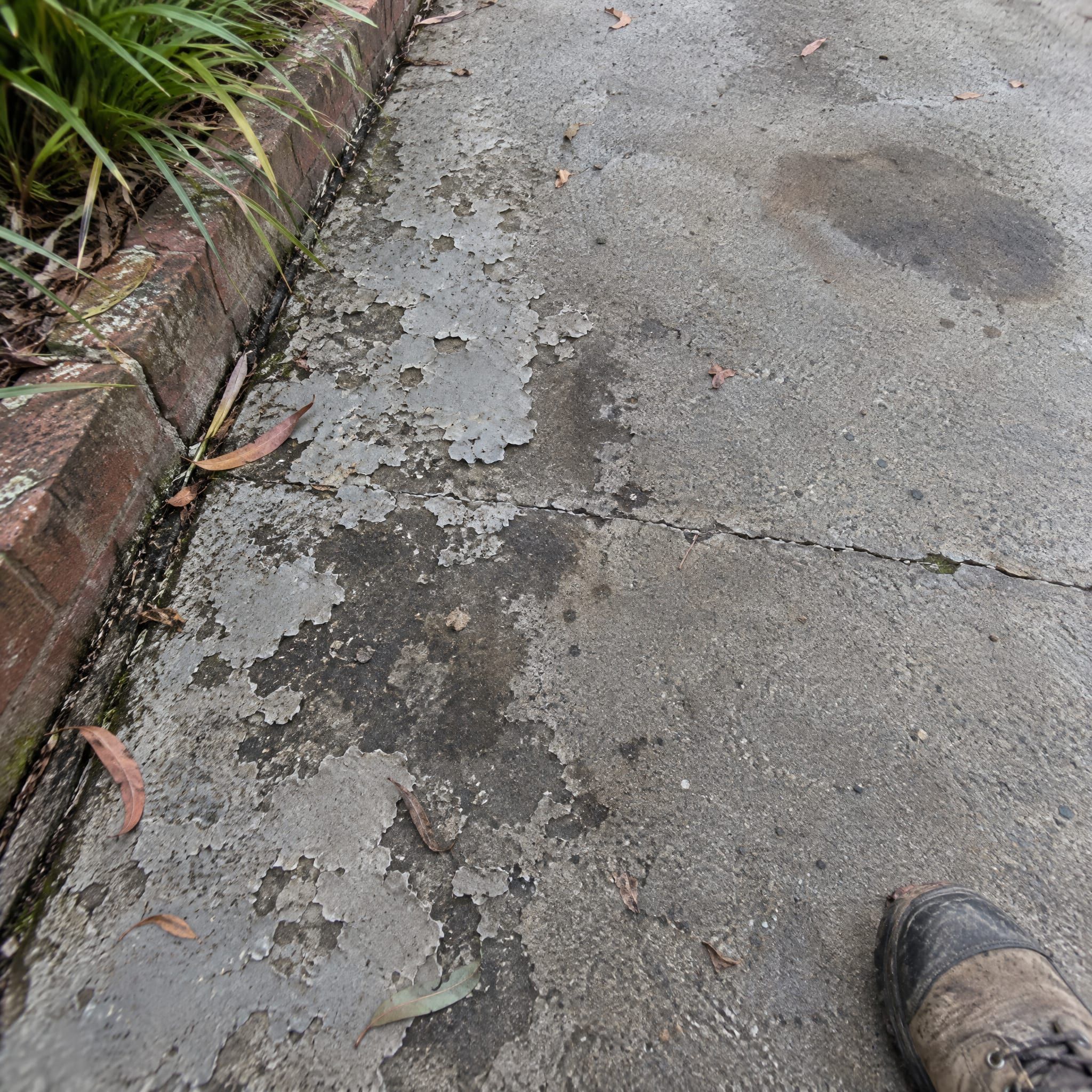
Because the sealer goes over whatever is still there. Seal over oil, growth, a failed old sealer or a damp slab and the problem is locked in underneath.
The usual results:
- Whitening or a cloudy film - moisture trapped under the sealer, often because the slab was not dry when it was sealed
- Peeling and flaking - new sealer laid over an old one it is not compatible with, or over a surface that was never opened up to take it
- Dark patches that come back - oil cleaned off the surface but still held in the concrete below
- White deposits returning - efflorescence, the salts that ride up through damp concrete, sealed in rather than dealt with
Cleaning matters, but it is a preparation step inside this work. It is never the service on its own, and a slab that has only been washed has not been restored.
What we diagnose first
Before any recommendation, we inspect the slab and photograph it:
- Cracks - their type, width, any lip or displacement, and whether they are moving
- Spalling - where the surface has flaked or broken away, and whether rust staining points to reinforcement sitting too close to the surface
- Joints - open, broken or full of growth
- Contamination - oil, rust, tyre marks, growth and efflorescence
- Existing sealer - what type it appears to be, whether it is still bonded and whether a new sealer will be compatible with it
- Moisture and drainage - where water sits, which areas stay damp and whether the falls send water towards the house
How are cracks in a concrete driveway repaired?
By type. A crack is a symptom, and the concrete repair depends on what caused it.
- Hairline shrinkage cracks are usually stable. They are filled with a compatible repair material, or sealed over where filling would show more than the crack itself.
- Cracks at control joints, the grooves cut so a slab cracks in a straight line, are the joint doing its job. They are cleared and resealed with a flexible joint sealant.
- Cracks with a lip or a widening gap show movement. The cause is investigated first, because a rigid repair across a moving crack opens up again.
- Spalls are cut back to sound concrete and rebuilt. Where rust shows corroding reinforcement, the steel is treated before the patch goes on, or the scope says that section needs replacing.
Repairs in an existing slab rarely disappear completely. We tell you before work starts how visible they are likely to be, and whether a colour coat or tinted sealer will even them out.
Our guide on reading cracks before you coat them goes through each type in more detail.
Recolouring and sealing
Once the slab is prepared and repaired, the finish goes on.
- Recolouring with a tinted sealer or colour coat evens out faded coloured concrete and softens the look of repairs. A tint softens patching. It does not hide a broken surface. See the colours on our driveway paint colour chart.
- Sealing protects the surface from staining and water and can bring back depth of colour. Penetrating sealers soak into the concrete and leave its look largely unchanged. Film-forming sealers sit on the surface and give a sheen or a wet look.
Sealing a concrete driveway only works on a dry slab. That is a hold point, a stage where work stops until a check is passed. No sealer goes on until the slab passes its moisture check, and we record it. Rain, temperature and wind decide whether the sealer goes down that day. Walls, doors, cars, gardens and the neighbours’ surfaces are masked, and if overspray from a sprayed sealer cannot be adequately controlled, we do not spray.
Resealing exposed aggregate
Exposed aggregate is concrete with the top layer washed back to show the stones in the mix. Its sealer keeps the stones looking rich and helps the surface resist staining, and that sealer wears with sun, traffic and weather.
There is no single resealing interval that suits every driveway. It depends on the sealer type, how much sun and traffic the surface gets and how close it is to the coast. The signs are visible. Water no longer beads, the colour turns dull or chalky, or the sealer is wearing through in the wheel tracks.
Resealing is not just another coat. A sealer that has whitened or lifted is removed first, and the new sealer has to be compatible with whatever remains. Our guide comparing exposed aggregate and plain concrete covers the upkeep side of that choice.
What your quote will name
- The condition found, with photographs
- What is included and what is excluded
- Each repair, by location and type
- How existing sealer and contamination will be dealt with
- The sealer or colour coat by type and name, and the number of coats
- The moisture check, and what happens if the slab is not dry
- How the site is protected, and when the surface can be walked and driven on
- The completion documentation and the maintenance pathway
If something concealed turns up once work begins, we stop, photograph it and send a written variation. Nothing proceeds without your approval.
Evidence, not assurances
Every restoration closes with a completion record: the condition found, the repairs made, the sealer applied, the moisture check, before, during and after photographs, and what to watch for before the next reseal.
If your driveway was cleaned and sealed and looks the same six months later, the cause is usually underneath. Request a free inspection and we will show you what the slab needs before anything is sealed.
The SOAKD Pathway
How this job runs, start to finish
- 01 Diagnose
- 02 Decide
- 03 Deliver
- 04 Defend
- 05 Document