
The short answer
Exposed aggregate shows the stone in the mix for a textured, mottled surface that hides marks well and needs regular sealing. Plain concrete is a broom or smooth finish that costs less per square metre and shows stains more. Both depend on the base under them. If the existing slab is sound, resurfacing can change the look without a pour.
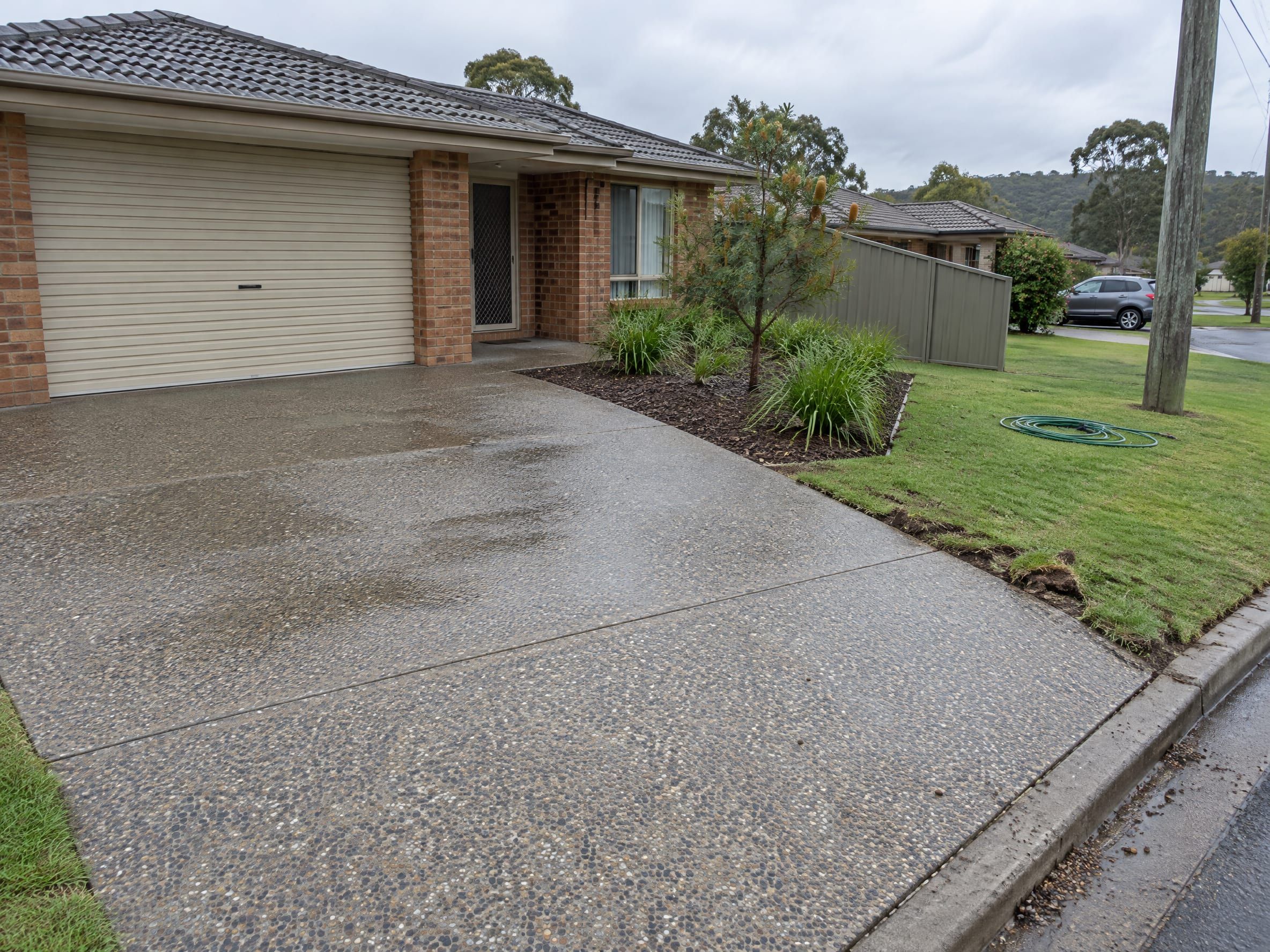
Exposed aggregate and plain concrete are two finishes on the same thing, a concrete slab. Exposed aggregate has its surface washed back to show the stone in the mix. Plain concrete is finished with a broom texture or a smooth trowel. The finish decides the look, the grip and the upkeep. The base, reinforcement and drainage under it decide how well the driveway performs. And if your existing slab is sound, a resurfaced finish may give you a new look without a new pour.
How is each finish made?
Every finish starts the same way. The ground is excavated and the subgrade, the natural ground the slab sits on, is prepared and compacted. A base layer goes down where the design calls for one. Formwork, the timber or steel edges that shape the slab, is set to the levels and falls, and the reinforcement steel goes in. We check all of that at a pre-pour hold point, a recorded check that must pass before the concrete arrives. Only then does the finish come into it.
- Plain concrete. The concrete is placed, levelled and floated, then finished. A broom finish leaves fine ridges across the surface for grip. A steel trowel finish is smooth and dense, and is better suited to covered areas than to an open driveway.
- Coloured concrete. Colour goes into the mix or onto the surface during finishing, and the slab is then finished like plain concrete.
- Exposed aggregate. The mix contains a decorative stone, or stone is spread into the surface while it is still workable. Once the concrete has begun to set, the thin layer of cement paste on top is washed away to expose the stone. Timing matters. Too early and stones loosen. Too late and the paste will not come away evenly. The surface is cleaned of residue and sealed once the slab is ready.
Cure is the period after the pour when concrete gains strength and gives up moisture. A sealer or coating applied before the slab is ready can trap that moisture and cloud or lift, so cure and moisture readiness before coating is another of our hold points.
Which finish has better grip?
Both can be finished for good grip, and both can be made slippery by the wrong sealer.
A broom-finished plain driveway has a consistent texture across the whole slab. A smooth trowelled finish is slippery when wet and is a poor match for a sloping driveway. Exposed aggregate grip depends on the stone, its size and how deeply it is exposed. Rounded river pebbles exposed lightly generally give less grip than angular stone exposed further.
Sealers change the picture. A glossy sealer can make either finish slippery in the rain, so on a driveway the sealer system should include a slip-resistant additive where the slope, shade or use calls for it. Plenty of driveways on the hillsides around the Central Coast, Lake Macquarie and Newcastle are steep, which makes grip a design decision to settle before the pour, not an afterthought.
How do they handle sun, salt and staining?
Differently, mostly because of colour and texture.
- Staining. Plain grey concrete shows oil drips, tyre marks, rust and mould. The mixed colours and texture of exposed aggregate hide marks better, though oil still soaks into an unsealed surface or a worn sealer.
- Growth. Shaded, damp sections of any driveway grow mould and lichen. Textured surfaces hold it in the texture, so they are cleaned as a preparation step before any resealing.
- Heat. Darker stones and coloured concrete absorb more sun than light grey concrete, and are warmer underfoot on a summer afternoon.
- Salt air. Near the water, salt and constant moisture wear sealers faster, so a coastal driveway may need resealing toward the shorter end of any recommended interval.
How much maintenance does each one need?
Exposed aggregate relies on a sealer to hold the colour of the stone and to keep the surface from soaking up stains. Plain concrete can be left unsealed, but it stains more readily without one.
Dulux Avista, a sealer and resurfacing manufacturer, recommends resealing driveways about every two years, sooner under heavy traffic, dirt or tyre friction. It describes a surface that looks faded and patchy when dry and darkens when wet as the sign that resealing is due. That interval is general manufacturer guidance for driveways rather than a fixed rule, and shade and coastal exposure change it.
On a driveway that is otherwise sound, resealing sits within concrete restoration and sealing, with cleaning carried out only as preparation for the new sealer.
Which finish suits which driveway?
There is no single right finish. There is a finish that suits the site, the slope and the way you use the driveway.
- Exposed aggregate suits a driveway that is a visible part of the house front, where hiding tyre marks and stains matters, and where you are comfortable resealing on a regular cycle.
- Plain broom-finished concrete suits a driveway where cost per square metre, consistent grip and simple upkeep come first, and where some staining over time is acceptable.
- Coloured or stencilled concrete suits a slab that needs to match or complement the house, though colour can fade over time and the surface generally benefits from a sealer.
- A resurfaced finish suits a sound existing slab where the levels and drainage already work and the goal is a new look rather than a new driveway.
Steep or shaded driveways shift the weighting toward grip. Coastal sites shift it toward sealer maintenance. The inspection records both, so the finish is chosen with the site in mind, not from a sample board alone.
What do public cost guides say per square metre?
Exposed aggregate costs more than plain concrete, mainly because of the decorative stone, the extra finishing steps and the sealing. What’s The Damage, a Sydney cost-guide site, publishes the following ranges in its concreting cost guide updated November 2026, GST included.
| Finish (per square metre) | Low | Typical | High |
|---|---|---|---|
| Plain concrete slab | $86 | $125 | $170 |
| Coloured concrete | $110 | $160 | $230 |
| Exposed aggregate | $140 | $185 | $230 |
| Stamped or stencilled | $140 | $180 | $230 |
| Spray-on resurfacing of an existing slab | $57 | $75 | $92 |
| Old concrete removal and disposal | $34 | $69 | $115 |
For a typical 40 square metre driveway, What’s The Damage’s guide lists totals of $3,000 to $6,900 for plain concrete and $5,500 to $10,350 for exposed aggregate.
These are Sydney figures from an aggregator that also generates trade leads, and they are not our prices. Rates on the Central Coast, in Lake Macquarie and in Newcastle differ, and a real quote moves with access, demolition, excavation, drainage, reinforcement, thickness and the crossover.
Can a resurfaced finish give the look without a pour?
Sometimes. If your existing slab is sound, level and drains properly, a resurfacing overlay can change its colour and texture without demolition. An overlay is a thin cement-based layer bonded to the existing slab and then sealed. It can carry colours, textures and stencilled patterns.
It is not the same as a poured exposed aggregate slab. Some overlay systems are designed to give a stone-look finish, but in a poured exposed aggregate driveway the stone is part of the concrete itself. If a stone finish is what you want, ask the quote to say exactly which of the two is being proposed. Every concrete quote we write names the actual system.
Resurfacing also does not change the slab under it. If the driveway is cracked and moving, has sunk sections or sends water the wrong way, an overlay will not fix any of that. Our guide to resurfacing, painting or replacing a driveway compares the three options, and our guide on whether you can resurface a cracked driveway explains how the cracks decide it. Where the slab qualifies, our concrete resurfacing and protective coatings service covers the work.
What else changes the price of a new driveway?
The finish is only one line on the quote. These items often move the total more.
- The council crossover. The section of driveway between your boundary and the road, often called the crossover or vehicle crossing, usually sits on council land. Councils set their own requirements and approvals for building or changing it, so check with your council before the work is scheduled. What’s The Damage notes, for example, that in the City of Sydney a driveway needs approval before it is built, repaired or changed, and that other councils have their own rules.
- Drainage. The falls of the driveway, grated drains at the garage and where the stormwater goes.
- Demolition and disposal of the old slab, and excavation to the right depth.
- Access for the concrete truck, or a concrete pump where the truck cannot reach the formwork.
- Levels at the garage, the house and the boundary.
- Trees and roots near the line of the slab.
- Thickness, reinforcement and joints suited to the vehicles that will use it.
Design, install, cure and coat under one scope
New driveways go wrong when the slab and the finish are planned by different people. On new concrete we run design, install, cure and coat under one scope through our concrete design and installation service.
The base, formwork and reinforcement are checked at the pre-pour hold point. The finish and the grip are chosen before the pour, not after. The sealer goes on only once the slab passes the cure and moisture readiness check. If something concealed turns up once work begins, such as old footings or a buried pipe, we stop, photograph it and send a written variation. Nothing proceeds without your approval.
Every stage is photographed, and the completion report records the base, the finish, the system applied and the maintenance pathway from here.
Get the driveway assessed
If you are choosing between exposed aggregate, plain concrete and a resurfaced finish, the first question is whether the existing slab can stay. We inspect the driveway, photograph the condition, levels and drainage, and explain which pathway the condition supports before any price is discussed. The inspection is free, across the Central Coast, Lake Macquarie, Newcastle and Sydney.
Request an inspection, or read about concrete design and installation if you are planning a new slab.
Sources
- Concreting Cost Sydney 2026 - What's The Damage
- How often should I reseal my driveway? - Dulux Avista
Figures quoted from third-party sources are theirs, as published at the time of writing. They are general information, not a quote or a statement about SOAKD Roof & Concrete's work.