
What strata managers are accountable for
You answer to the committee, the owners, the insurer and the minutes. When roof or concrete work goes wrong, the complaint comes to you, and so does the question of why that contractor was chosen.
The failures are predictable. A one-line quote with no scope, no photographs and no inclusions. A recoat over failed ridge pointing that leaks into a top-floor unit the next winter. Storm damage tarped with no report for the insurer. A quote that looked lowest until the variations arrived.
The lowest compliant quote only protects you if it describes the same work as the others. Most do not. Our scopes are written so they can be compared, minuted and filed, and every job follows the SOAKD Pathway. Diagnose, decide, deliver, defend, document.
Who is responsible for the roof and driveways?
In many strata schemes the roof, the driveways and the shared paths are common property, which puts them with the owners corporation. That is not true of every scheme. The strata plan, the by-laws and your strata manager decide what is common property and who is responsible for it.
We scope to whatever the strata manager or committee confirms. We do not advise on strata law.
A scope the committee can minute
A committee should be able to approve our scope as it is written. Each one states:
- The condition found, with photographs, building by building
- The recommended pathway, repair, restore or replace, and the reason for it
- Inclusions, exclusions and assumptions
- The repairs by location, and by quantity where they can be measured
- The coating, sealer or roofing system by name
- Access, site protection and how residents are kept clear of the work
- The hold points, the stages where work stops until a check is passed and recorded
- How concealed conditions are handled
- The completion documentation the strata file receives
If something concealed turns up once work begins, we stop, photograph it and send a written variation. Nothing proceeds without approval.
The same structure helps with the capital works fund, which many owners still call the sinking fund. Findings are separated into what needs attention now and what can be planned, so the work can be lined up with the fund and the committee’s priorities.
Photographed condition reports across the scheme
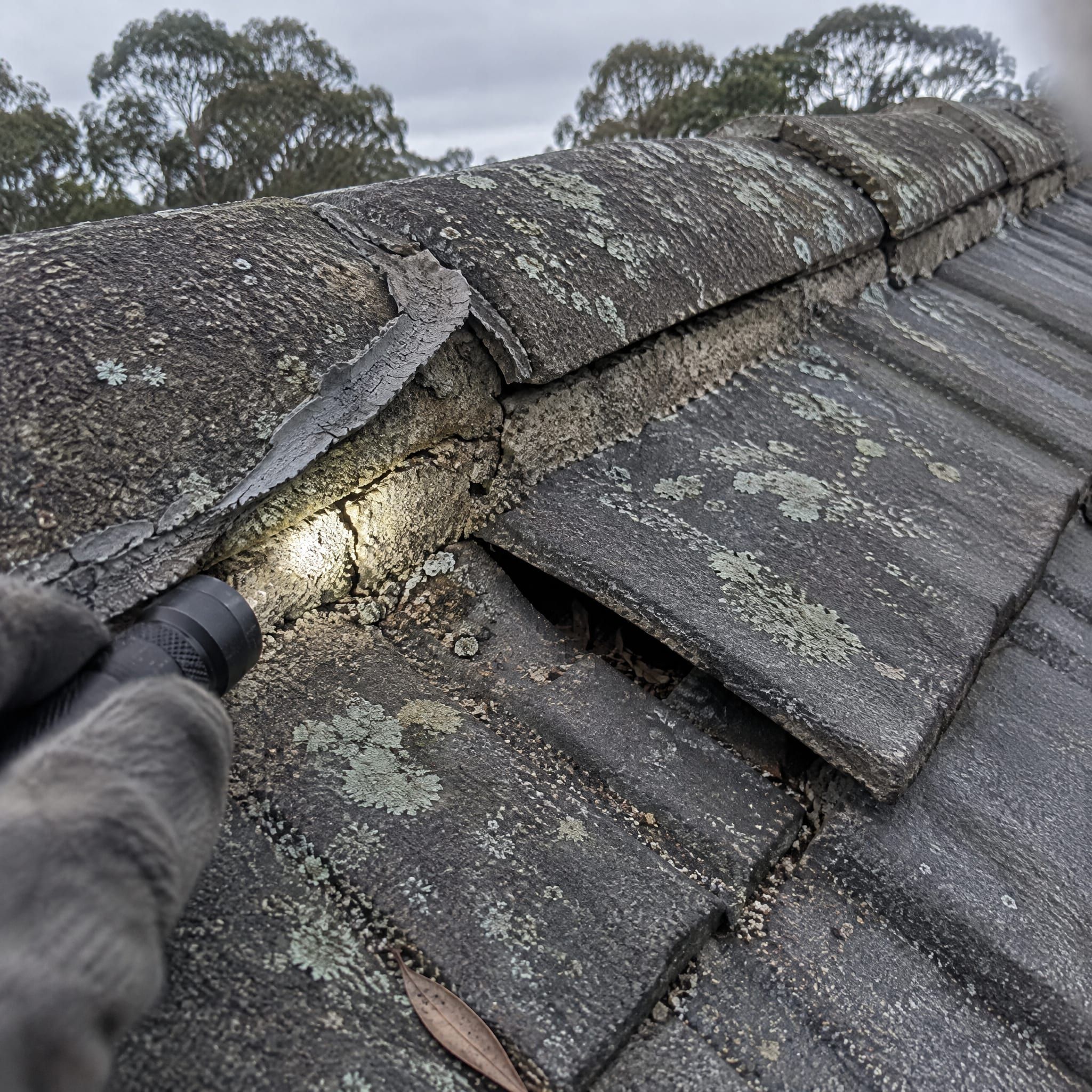
Before any recommendation, we inspect the accessible areas of each roof and the common property concrete, and photograph what we find. On tile roofs that means tiles, valleys, flashings and ridge lines. Flashings are the strips that seal joints and edges. Bedding is the mortar that holds the ridge caps in place, and pointing is the flexible compound that seals over it. On metal roofs it means fixings, corrosion, laps and flashings. On driveways and paths it means cracks, lifted edges, drainage and existing coatings.
Roof diagnosis and quoting are led by Daniel, the founder of SOAKD and director, who has more than 20 years in high-risk construction and industrial environments. Our guide on repairing, restoring or replacing a roof sets out the condition signs behind each recommendation.
Staged works across multiple buildings
Townhouse complexes, villa groups and retirement villages rarely need, or can fund, everything at once. We stage the work building by building or area by area. Each stage has its own scope, hold points and completion record. The committee can approve one stage, see it finished and documented, and then approve the next.
Shared driveways and paths are staged around access. We plan the sequence so residents keep a way in and out wherever the site allows, and the scope states when each section is closed and when foot traffic and cars can return. Where a slab is cracked or lifted, concrete restoration deals with the repair before any sealer or coating goes on.
Communicating with residents
Many complaints about roof and concrete work in a strata scheme come from residents who did not know it was happening. We agree the communication plan with the strata manager before work starts and provide the details for a resident notice. That covers dates, areas affected, parking and driveway access, and what needs to be kept clear on coating days.
Coating needs a dry surface and wind that allows overspray to be controlled. If overspray cannot be adequately controlled, we do not spray. When the weather moves a coating day, the strata manager hears first, with the reason.
Make-safe reports after storms
After a storm, the committee and the insurer need the same thing, a record of what happened and what was done. Where the roof can be accessed safely, we carry out a make-safe, the temporary work that reduces hazards and limits water getting in. The report records the damage found, the photographs, the temporary work and the recommended permanent repair.
The permanent repair is then quoted as a scope the committee or insurer can review. Our page on emergency roof repairs and make-safe explains how a storm call runs.
What to ask any contractor before the committee approves
These questions put every quote on the same footing.
- Can we see photographs of the condition, building by building?
- Is the recommendation repair, restore or replace, and why?
- What is included, what is excluded and what has been assumed?
- Which system will be used, by name?
- What are the hold points, and how is each one recorded?
- How are concealed conditions handled, and who approves a variation?
- How will residents, cars and neighbouring property be protected?
- What does the strata file receive at completion?
- Can we see your licence and insurance details for this work, so we can check them?
If two quotes cannot answer the same nine questions, they are not quoting the same job.
Request a strata inspection
We work with strata managers and owners corporations across Newcastle, Lake Macquarie, the Central Coast and Sydney. The inspection is free. Request an inspection or call 0468 029 068.