
Roof leaking now? Call 0468 029 068
If water is coming through your ceiling or your roof has been damaged in a storm, call 0468 029 068. It is one number for everything, including emergency and urgent roof repairs across the Central Coast, Lake Macquarie, Newcastle and Sydney.
Tell us what you can see, where the water is, and whether anyone is in the room underneath. We ask about safety first and the roof second. That order does not change.
Before anything else, make the house safe
Your safety comes before the roof. While you wait:
- Keep people out of rooms under the damage. A ceiling holding water is a hazard.
- Stay clear of water near power points, lights or the switchboard. If water has reached anything electrical, call a licensed electrician.
- Do not go up on the roof. A wet or damaged roof is a fall risk, and storm conditions change quickly.
- Move belongings and catch drips only if it is safe. Nothing in the room is worth an injury.
- Photograph the damage only if it is safe to do so. Photos taken from inside are useful. They are not worth a risk.
If anyone is in danger, call 000. For help with storm damage at home, the NSW SES takes calls on 132 500.
What to tell us when you call
A few details on the phone let us plan the visit and bring the right materials. If you can, have these ready:
- The address, and whether you own, rent or manage the property
- Where the water is coming in, and roughly when it started
- Whether water is near anything electrical
- The roof type, if you know it, such as concrete tile, terracotta or metal
- Whether there are solar panels, skylights or anything else on the roof
- What caused it, if you know, such as wind, hail or a fallen branch
- Who else needs the report, such as your insurer, a strata manager or a builder
You do not need all of it. Call anyway, and we will work through the rest with you.
Leaking roof or storm damage: common causes
Not every emergency roof leak comes from a storm. Heavy rain can find a weakness that has been building for months.
- After heavy rain, the usual causes are a blocked or overflowing valley, a cracked tile, failed ridge pointing or a flashing that has lifted or lost its seal.
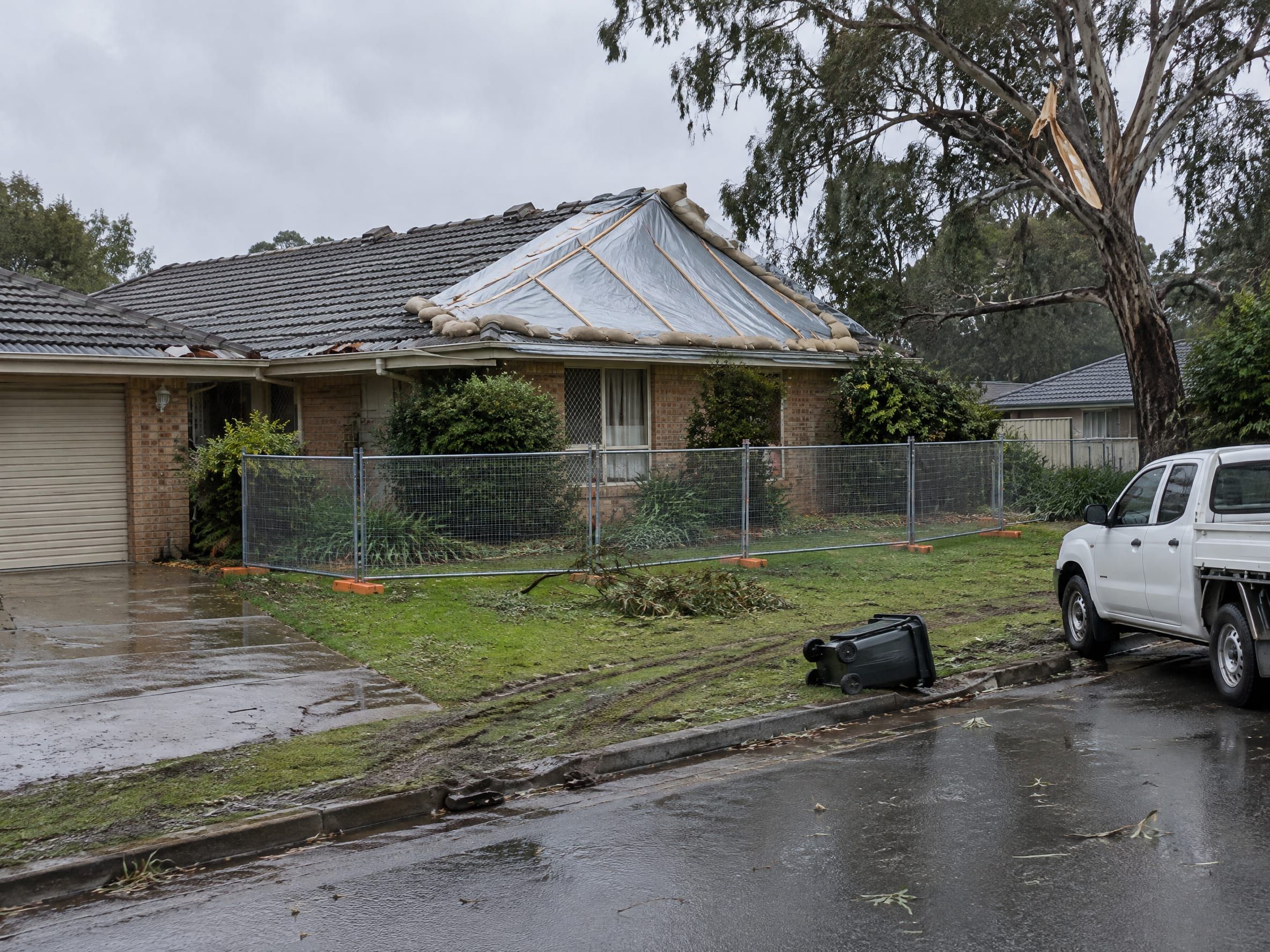
- After a storm, add wind-lifted sheets and ridge caps, tiles broken by hail or debris, and branches through the roof.
The make-safe deals with the water getting in now. The report records which cause we found, because that decides what the permanent repair needs to be.
What a make-safe is
A make-safe is temporary work that reduces hazards and limits water getting in until the permanent repair can be done. It is the term builders, insurers and strata managers use for the first visit after storm damage.
Depending on the damage and the conditions, a make-safe can include:
- Emergency roof tarping, a tarp fixed over the damaged area so it sheds water away from the opening
- A temporary sheet over a hole or a missing section of roof
- Refixing or removing loose tiles, sheets, ridge caps or flashings that could move in the wind
- Clearing a blocked valley or gutter that is sending water inside
A tarp is short-term by design. Wind lifts it and sun breaks it down. That is why the pathway to the permanent repair is written as part of the make-safe, not left for later.
What happens when we attend
We work on a damaged roof only when it is safe to. If wind, rain or lightning make the roof unsafe, we do not go up, and we tell you why and what can be done in the meantime. The crew’s safety is part of the job.
When the roof can be accessed safely, we:
- Look at the damage and the likely points where water is getting in
- Photograph it before anything is touched
- Carry out the make-safe
- Photograph the make-safe
- Record what still needs doing
Water rarely enters directly above where it drips, so the damage on the roof is not always above the stain inside. Our guide on why a roof leaks explains how water travels between the entry point and the ceiling.
Storm damage roof repair starts with a report
The make-safe report is the record of the visit. It is written in plain English and states:
- The address, the date and the conditions on the day
- The damage found, with photographs
- The temporary work carried out, with photographs
- What the make-safe does not address
- The recommended permanent repair, and why
Your insurer may ask for photographs and a report. Check your policy. We do not speak for your insurer, and we do not tell you what your policy covers.
For builders, property managers and strata managers
If you manage the property rather than live in it, you need a record you can file, not a phone call. The make-safe report is written so it can go straight into an insurer file or a committee file, with the photographs, the work done and the permanent repair named.
The permanent work is then quoted as a scope, with inclusions, exclusions, assumptions and the materials or system named. It can be put to an owner, a committee or an insurer as it stands.
One number covers the make-safe and the permanent repair. Call 0468 029 068.
From make-safe to the permanent repair
Every make-safe ends with a written pathway to the permanent repair. The pathway depends on the damage and on the condition of the rest of the roof.
- A storm that broke tiles or lifted a flashing on an otherwise sound roof usually needs roof repairs.
- Damage on a roof whose pointing or coating had already failed may point to a roof restoration.
- Widespread damage, a compromised structure or an asbestos roof can make roof replacement the honest answer.
The permanent repair is quoted in writing, and you decide when it goes ahead. If a concealed condition is found once work begins, we stop, photograph it and send a written variation. Nothing proceeds without your approval.
Not leaking now?
If the storm has passed, nothing is coming in and you want the roof looked at, you do not need an emergency visit. Request a free inspection, or call the same number, 0468 029 068.
The SOAKD Pathway
How this job runs, start to finish
- 01 Diagnose
- 02 Decide
- 03 Deliver
- 04 Defend
- 05 Document