
The short answer
Bedding is the mortar bed that holds ridge and hip caps in place. Pointing is the flexible seal over it. If the caps are firm and only the pointing has cracked, a repoint can be enough. If the bed has cracked or caps move, the ridge must be rebedded and then repointed. Pointing over failed bedding hides the fault.
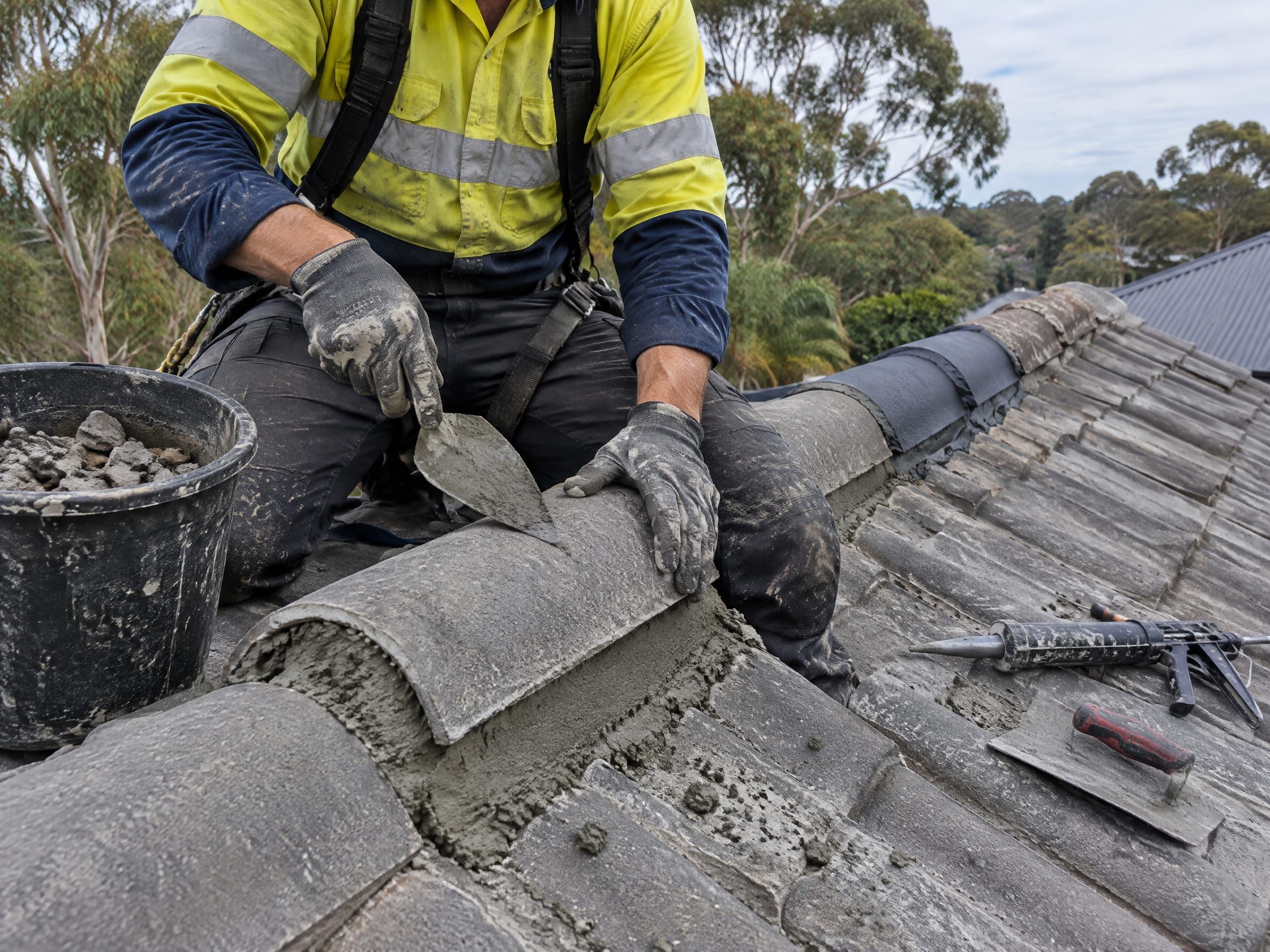
Rebedding and repointing are two different repairs to the same part of a tile roof. The ridge and hip caps sit on a bed of mortar, and a flexible pointing compound seals over the edge of that bed. Which repair you need depends on which layer has failed. Get it wrong and you either pay for work the roof did not need, or pay to seal a cap that is no longer held in place.
What bedding and pointing each do
Bedding holds the caps. Pointing seals them.
Ridge caps are the curved tiles that run along the top of the roof. Hip caps run down the sloping external corners. Both sit on bedding, a sand and cement mortar laid along the ridge, which fills the gap between the caps and the tiles below and holds the caps in line.
Pointing is the thin layer applied over the exposed edge of the bedding. Its job is to seal the joint against water and give the ridge line a finished edge. Modern flexible pointing compounds are designed to move slightly as the roof heats, cools and flexes in the wind, rather than crack.
Both sit on the same line of the roof, which is why the two words get used as if they meant the same thing. They do not, and they fail in different ways.
Rebedding vs repointing at a glance
| Question | Repoint | Rebed and repoint |
|---|---|---|
| What is replaced | The pointing only | The mortar bed and the pointing |
| What happens to the caps | Left in place | Lifted, reset in a new bed, then pointed |
| When it suits | Firm caps, sound bedding, cracked or worn pointing | Loose or misaligned caps, cracked or crumbling bedding |
| What goes wrong if misjudged | A new seal over a cap that is no longer held | Paying to rebed ridges that were still sound |
Signs the pointing has failed but the bedding is sound
If the caps are firm and in line and only the surface seal has broken down, the pointing is the problem. A repoint can be enough.
Signs that point to a repoint:
- Fine cracks, gaps or hairline splits along the pointing
- Pointing that is lifting, flaking or pulling away at the edges
- Faded or patchy pointing, with the bedding behind it still solid
- Caps that do not move when pressed and sit in a straight line
A repoint removes the loose and failed pointing, prepares the joint and applies new flexible pointing over the sound bedding.
Signs the bedding has failed
If the caps move, have shifted out of line or the mortar underneath is breaking up, the bedding has failed. The caps need to be lifted and rebedded, then pointed.
Signs that point to a rebed:
- Caps that rock or move when pressed by someone on the roof
- A wavy ridge line, or caps visibly out of line from the ground
- Mortar crumbling or falling out in pieces, sometimes found in the gutters or on paths below
- Gaps under the caps, or daylight visible along the ridge from inside the roof space
- Leaks along the line of a ridge or hip, or birds and pests getting in under the caps
- Cracked or broken caps
Vivify Roofing’s guide to bedding and pointing, published May 2026, makes the same point about loose tiles. Loosening suggests the bedding has lost its hold and needs replacement.
A rebed lifts the caps, removes the old bedding, lays a new bed, resets the caps in line and then applies flexible pointing over the new bed.
Why pointing over failed bedding wastes money
New pointing over a failed bed seals the surface of a cap that is no longer held. The cap still moves, the new pointing cracks along the old fault, and water finds its way back in. You pay for the repair twice.
This is where confusing the two repairs costs money. If one roofer has quoted a repoint and another a rebed on the same roof, the difference usually comes down to this question. Ask each of them to show you the condition of the bedding, not just the pointing.
Our position is simple. We do not repoint over cracked bedding. If the bed has failed, the quote says rebed and repoint, and the photographs show why.
The reverse also happens. A full rebed on ridges where the bedding is still sound is work the roof did not need. The inspection should show which ridges have failed and which have not, so the quote can be partial where that is all the roof needs.
Partial or full: does every ridge need the same work?
Not always. Ridges fail at different rates, so a roof can have one ridge that needs rebedding and others that need only a repoint, or nothing at all.
Exposure is the usual reason. The ridge facing the prevailing wind, a hip above a valley that carries a lot of water, or a section disturbed by another trade can fail first. A partial rebed on the sections that have failed, with repointing elsewhere, can be the right scope.
A full rebed makes sense when the bedding has failed along most ridges, when the original mortar is breaking up roof-wide, or when the ridge work is part of a restoration and the whole roof is being brought to the same standard. The inspection photographs should make the case either way, ridge by ridge.
Why flexible pointing replaced cement mortar
Older roofs were usually pointed with a rigid cement-based mortar. Ridges move as the roof heats and cools and as wind loads it, and a rigid joint cracks under that movement. Flexible pointing compounds are made to accommodate it.
Vivify Roofing’s guide notes that most tilers now prefer flexible compounds for pointing instead of a mortar mixture. On older roofs, cracked original cement pointing is often the first visible sign of ridge wear.
Published lifespan figures for ridge work vary, and they come from cost guides and vendors rather than independent testing. The Quote Yard’s NSW rebedding cost guide, published January 2026, says rebedding done properly should last 25 to 30 years or more, and that flexible pointing over new bedding may need attention at around 15 to 20 years. Treat those as one source’s figures, not a promise for any particular roof. Coastal exposure, roof movement and the quality of the bed under the pointing all change the result.
When ridge work is enough and when it is part of a restoration
Ridge work on its own suits a roof whose tiles and surface are still sound. If the tile surface has worn out as well, the ridge work becomes the first stage of a full restoration.
Standalone ridge work fits when:
- The tiles are sound, with no widespread cracking, porosity or heavy lichen
- The ridge and hip lines are the only part of the roof that has failed
- Only some ridges are affected, so a partial rebed or repoint is enough
Ridge work belongs inside a restoration when:
- The tile surface is faded, porous or covered in lichen across the roof
- Other repairs are spread across the roof, such as cracked tiles and worn valleys
- You want the roof coated, because repairs must be done before any coating goes on
In a restoration the order is fixed. Repairs, including rebedding and repointing, come first. Then the roof is cleaned as preparation, dried, primed and coated. Coating over failed bedding hides the fault rather than fixing it. Our roof restoration page explains the full sequence, and our guide to restore, repair or replace sets out how the four tiers are decided.
What public cost guides say about ridge repairs
Published ranges for ridge work vary widely. The total depends on how many metres of ridge and hip need work, the height and pitch of the roof, access, and how many caps need replacing.
- The Quote Yard’s NSW rebedding cost guide, published January 2026, lists repointing at $40 to $80 per metre and rebedding at $80 to $120 per linear metre, and puts complete rebedding of a typical three-bedroom home at $2,200 to $4,500.
- What’s The Damage’s Sydney roof restoration guide, updated November 2026, lists full rebedding and repointing at $920 to $4,025, typically $2,525.
- The Quote Yard’s NSW roof leak repairs guide, published September 2026, lists rebedding and repointing ridges at $2,500 to $8,000.
These are cost-guide figures, not independent testing, and they are not our prices. The spread between them is a reminder that “rebed and repoint” can mean a short section or every ridge on a two-storey roof. A quote that states the metres and the scope tells you far more than a headline figure.
What a proper ridge repair quote specifies
A ridge repair quote should let you see exactly which work is being done and why. Look for:
- Whether the work is a repoint, a rebed and repoint, or a mix, with photographs that show the condition of each ridge
- The metres of ridge and hip included, and whether the work is partial or full
- That old bedding is fully removed where rebedding is quoted, not patched over
- How cracked or broken caps are handled, and what happens if matching caps are not available
- The pointing compound and its colour
- How debris is managed and gutters left clear of mortar
- Whether the work stands alone or is the repair stage of a restoration
- The completion photographs you receive
If a concealed condition, such as damaged battens under the caps, turns up once the caps are lifted, we stop, photograph it and send you a written variation. Battens are the timber or steel strips the tiles hang on. Nothing proceeds without your approval.
Get the ridges checked
The inspection is free. We inspect the accessible areas of the roof, check the ridge and hip lines, photograph what we find and tell you whether the roof needs a repoint, a rebed and repoint, or more than ridge work.
Request a free inspection or call 0468 029 068. Ridge work on its own is covered on our roof repairs page. We work across the Central Coast, Lake Macquarie, Newcastle and Sydney.
Sources
- The difference between bedding and pointing - Vivify Roofing
- Roof Rebedding Cost 2026 NSW - The Quote Yard
- Roof Restoration Cost Sydney 2026 - What's The Damage
- Roof Leak Repairs NSW 2026 - The Quote Yard
Figures quoted from third-party sources are theirs, as published at the time of writing. They are general information, not a quote or a statement about SOAKD Roof & Concrete's work.