
One scope, one team, from design to coat
A new driveway usually involves several trades. One measures it up, a concreter pours it, and someone else is called later to seal or coat it. When something goes wrong, each points to the other.
We run it as one job. Design, installation and coating sit in one scope, delivered by one accountable team, with the finish decided before the concrete is ordered rather than after it has cured.
That covers concrete driveways, concrete paths, slabs, patios, courtyards and hardstands, the reinforced pads for parking, caravans, boats or bins. If you are comparing driveway concreters, the difference to look for is in the scope, not the brochure.
When is a new slab the right pathway?
When the existing concrete has failed at the base, not just at the surface. A new slab is the honest answer when:
- sections have sunk, lifted or broken up
- cracks have a lip or keep widening, showing the ground beneath is moving
- the falls send water towards the house or garage
- the driveway is too narrow, too steep or in the wrong place for how the property is used
If the slab is sound and only the surface is tired, resurfacing or restoration may be enough, and we will say so. Our guide on resurfacing, painting or replacing a driveway sets out the three options side by side.
Which finish suits your driveway?
The finish decides how the surface looks, grips, heats up in the sun and is maintained.
| Finish | How it is made | Things to weigh |
|---|---|---|
| Plain, broom finish | Concrete finished with a broom to give it texture | Simple and grippy. Shows stains and tyre marks |
| Exposed aggregate | The top layer is washed back to show the stones in the mix | Hides wear well. Needs periodic resealing |
| Coloured concrete | Colour added to the mix or applied to the surface | Colour can vary between pours. Darker colours run hotter underfoot |
| Stamped concrete | Patterned while the concrete is still workable, then sealed | Decorative. The sealer can be slippery when wet unless an additive is used |
| Coated | A plain slab finished after cure with a named coating system | Colour and texture are chosen at design, applied once the slab is ready |
If you are weighing an exposed aggregate driveway against plain concrete, our guide to the two covers the differences in grip, heat and upkeep.
The installation sequence
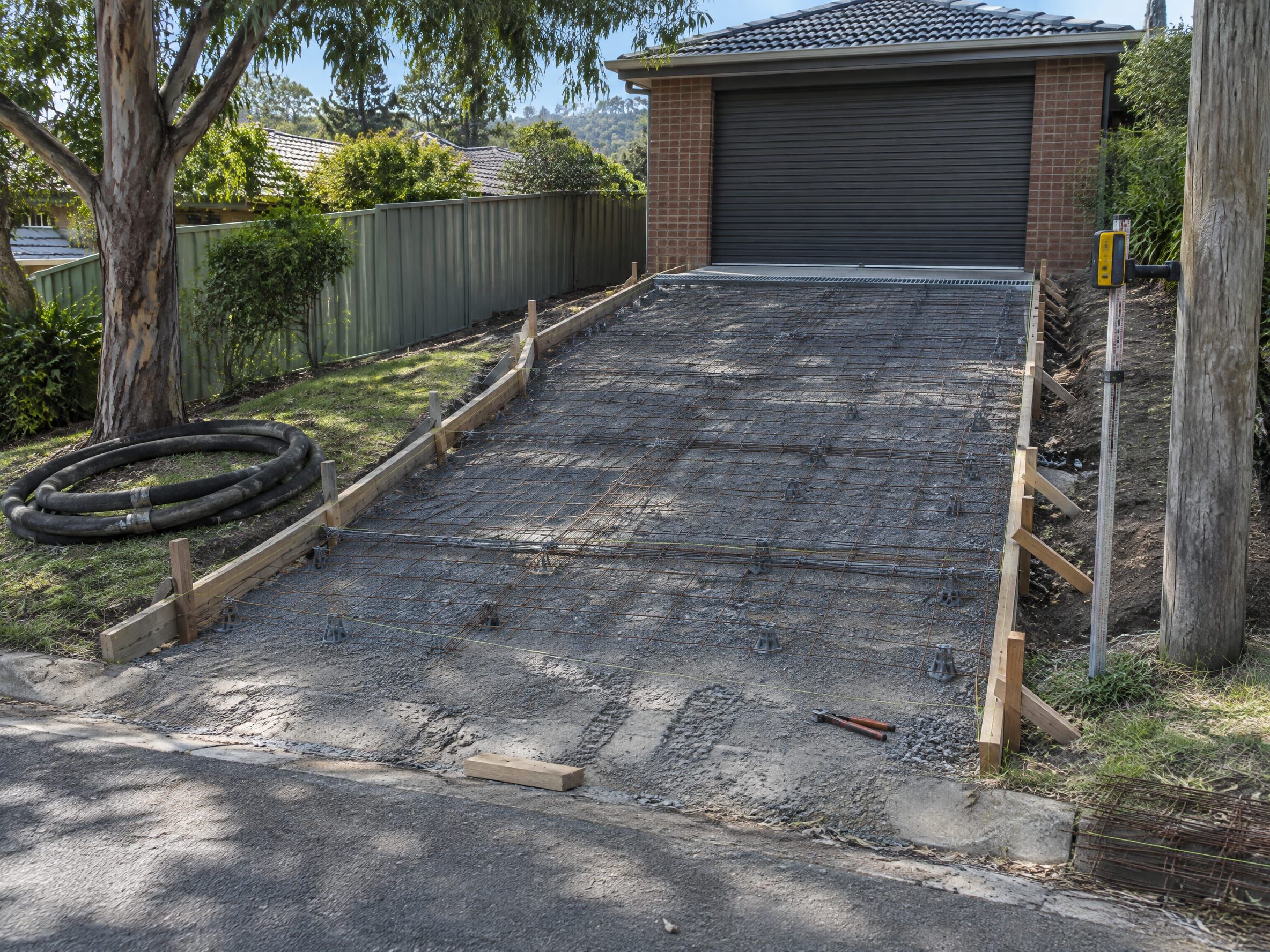
- Design. Layout, levels, falls (the slope that carries water away), thickness, reinforcement, joint positions, finish and drainage, agreed in writing.
- Site preparation. Any old slab is broken out and removed, and underground services are checked before excavation.
- Subgrade and base. The subgrade, the natural ground the slab sits on, is trimmed and compacted. A base layer of crushed rock is placed and compacted over it. A poorly compacted base is a common cause of later cracking and sinking.
- Formwork. The timber or steel edges that hold the concrete in shape are set to the design levels and falls.
- Reinforcement. Steel mesh or bar is placed on supports so it sits within the slab, where it does its work, rather than on the ground beneath it.
- Pre-pour hold point. A hold point is a stage where work stops until a check is passed. Before concrete is ordered, we check the base, formwork, levels, falls, reinforcement position and joint layout, and record it. If anything fails the check, the pour does not go ahead.
- Pour and finish. The concrete is placed, levelled and finished to the agreed surface.
- Jointing. Control joints, the grooves that set where a slab cracks as it shrinks, are cut or formed at the designed spacing. Expansion joints separate the slab from walls and existing concrete.
- Cure. The slab is protected from drying too fast. Cure is the period in which concrete gains strength and gives up its moisture, and a slab that dries too quickly is weaker at the surface.
- Coating readiness and coat. Where a sealer or coating is part of the scope, it waits until the slab has cured and passes a moisture check. That is a second hold point, recorded like the first.
Drainage, approvals and the street
A driveway moves a lot of water. The falls are designed to carry it away from the house, the garage and the neighbours to a suitable drainage point. Where new drainage is needed, the scope says what it involves and who does it.
Where the driveway meets the road, the crossover and kerb usually sit on council land. Your council may require approval for driveway crossovers - we will flag it at the design stage, so it is in the plan rather than discovered on pour day. Requirements differ between councils.
Why the coat is planned before the pour
The coating decision changes the slab. A surface that will be coated is finished to suit that system. An exposed aggregate slab needs the right stone in the mix from the start. Planning the finish at design avoids a new slab that has to be ground back before it can take the coat it was meant for.
New concrete also has to cure before it is coated. How long that takes depends on the mix, the thickness and the weather, which is why coating readiness is a recorded hold point rather than a date on a calendar.
We protect the site
Concrete work is heavy and wet. Paths, gardens, walls and neighbouring driveways are protected, and trucks and pumps are positioned to keep clear of them. Any sealer or coating that is sprayed follows the same rule as every job we do. If overspray cannot be adequately controlled, we do not spray.
What your quote will name
- The design, with layout, dimensions, thickness, falls and joints
- Base preparation and compaction
- The concrete mix, reinforcement and finish
- Drainage inclusions, and any council approvals needed and who is arranging them
- The pre-pour and coating-readiness hold points
- The sealer or coating system by name, where included
- Inclusions, exclusions, access and site protection
- The completion documentation you receive
If something concealed turns up once work begins, such as old footings, buried services or soft ground, we stop, photograph it and send a written variation. Nothing proceeds without your approval.
Evidence, not assurances
Every installation closes with a completion record: the design as built, the hold-point checks, the system applied, before, during and after photographs, and the maintenance pathway, including what to watch for before any reseal.
To start, request a free inspection. We will look at the ground, the falls and the street access, and talk through the finish before anything is drawn up.
The SOAKD Pathway
How this job runs, start to finish
- 01 Diagnose
- 02 Decide
- 03 Deliver
- 04 Defend
- 05 Document