
The short answer
A tired concrete driveway can be painted, resurfaced or replaced. Paint is a thin film that changes the colour of a sound, dry slab. Spray-on resurfacing is a cementitious overlay bonded to a stable slab to renew colour and texture. A new pour is the answer when the slab has moved, is breaking up or drains the wrong way.
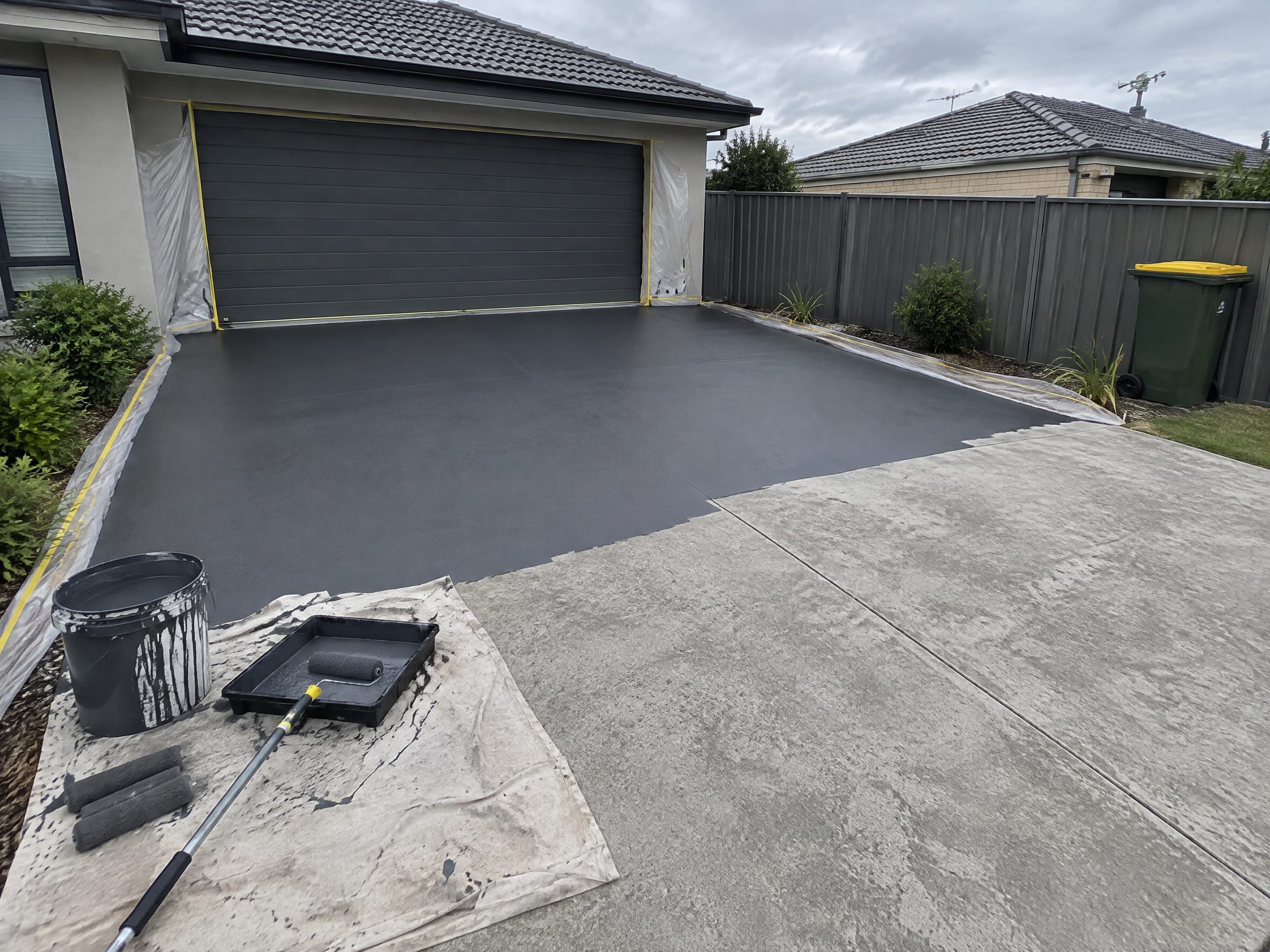
There are three ways to fix a tired concrete driveway, and they are not interchangeable. Paint changes the colour of a sound slab. Spray-on resurfacing bonds a thin cementitious layer to a stable slab and renews its colour and texture. A new pour replaces a slab that has moved, broken up or drains the wrong way. The condition of the slab decides which one fits, not the finish in the photo.
Why spray-on resurfacing is not paint
Spray-on resurfacing is a cementitious overlay. An overlay is a thin layer bonded to the existing slab, and cementitious means it is cement-based, usually modified with polymers so it grips the old concrete and tolerates small movement. Paint is a film of coloured binder that sits on top of the surface.
They can look similar from the street on the day they are finished. They are different products doing different jobs, and the difference shows up in three places.
- What it bonds to. An overlay is built onto the prepared surface of the slab, the substrate, and becomes part of the surface. Paint relies on a thin film holding onto concrete that is porous and often damp underneath.
- Build and texture. An overlay is applied in layers that can carry texture, colour and stencilled patterns, and is then sealed. Paint is a coloured film with little build of its own.
- How it wears. A worn overlay is resealed or recoated. A worn painted driveway usually peels in patches, often in the tyre tracks first, and the loose paint has to come off before anything else can go on.
The confusion is understandable because both are sprayed or rolled and both change the colour. It matters at quote time. Two quotes for a “resurfaced driveway” can describe very different systems, and only one of them may be an overlay. Our rule is that every concrete quote names the actual system. A painted surface is never called a resurfacing overlay.
When is paint enough, and when does it fail?
Paint can be enough on a sound, dry slab where the goal is a colour change and the traffic is light. A side path or a patio that is never driven on is a different job from a driveway that carries two cars every day.
Paint struggles in predictable conditions.
- Moisture from below. Concrete is porous. Where moisture moves up through the slab from damp ground, it pushes against the paint film and lifts it.
- Old sealers and contamination. Oil, rust, previous sealers and growth stop a film bonding. Cleaning is a preparation step, and some contamination goes deeper than a surface clean reaches.
- Tyres. Turning tyres scuff and lift a thin film, and hot tyres can soften some coatings and sealers. Driveways usually wear first in the tracks.
- Grip. Slip resistance is how well a surface holds a foot or a tyre when wet. A smooth painted finish can be slippery in the rain unless the system includes a slip-resistant additive.
None of this means paint is wrong. It means paint is a finish for a slab that has nothing wrong with it. If the slab is cracked, moving or holding water, paint changes the colour of the problem and leaves the problem where it was.
When is spray-on resurfacing the right middle option?
Resurfacing suits a slab that is structurally sound but looks worn. The concrete is stable and the levels and drainage work, but the surface is stained, patched, faded or covered in fine cracks.
A typical candidate is a plain grey driveway with two old patches, oil stains near the garage and a web of fine surface cracks, but no lips, sunken sections or broken edges.
What resurfacing can do:
- Give the whole slab one colour and texture, including over old patches
- Add a decorative finish such as a stencilled pattern or a textured coat
- Improve grip compared with a worn, smooth surface, depending on the texture and sealer
- Take a protective sealer that can be renewed over time
What it cannot do:
- Stop a slab that is still moving
- Correct falls that send water toward the house
- Rebuild broken edges, sunken sections or a failing base
An overlay is thin and bonded. It has no structural strength of its own, so whatever the slab underneath does, the overlay does too. That is why resurfacing starts with the slab, not the colour chart.
Dulux Avista, which manufactures resurfacing products, says a resurfaced driveway usually lasts between 10 and 15 years, and that the condition of the concrete determines how long resurfacing lasts. Those figures are the manufacturer’s, they assume a sound slab and good preparation, and they are not independent testing. The same manufacturer recommends resealing driveways about every two years, sooner under heavy traffic.
Cracks are where most resurfacing decisions are won or lost. Our guide to resurfacing a cracked driveway explains which cracks an overlay can go over and which ones it cannot.
When does the slab need to be replaced?
Replace the slab when the problem is in the slab, or in the ground beneath it, rather than on the surface. No coating corrects levels, drainage or a failing base.
Signs that point to a new pour:
- Lips and steps. One side of a crack sits higher than the other, which means a section has moved vertically.
- Sunken or lifted sections. Usually the subgrade, the compacted ground the slab sits on, has settled, washed out or swollen.
- Breaking edges. Edges that crumble where wheels run over them often mean the slab is thin or unsupported at the edge.
- Tree roots. Roots that have lifted the slab once will keep lifting it.
- Water going the wrong way. If the driveway ponds or sends water toward the garage or house, the falls need to be reset, and that means new concrete.
- Widespread structural cracking. Cracks that branch across most sections or have widened over time.
Replacement does not always mean the whole driveway. Sometimes one or two sections between joints have failed and the rest is sound. Replacing those sections and then resurfacing the whole driveway can give one consistent finish, provided the new concrete has cured first.
Cure is the period in which new concrete gains strength and gives up moisture. Coating too early traps that moisture under the new surface. Cure and moisture readiness is one of our hold points, a recorded check that must pass before the next stage starts.
How do the three options compare?
| Paint | Spray-on resurfacing | New pour | |
|---|---|---|---|
| What it is | A coloured film on the surface | A thin cementitious overlay bonded to the slab, then sealed | New concrete on a prepared base |
| The slab it suits | Sound, dry, lightly trafficked | Structurally sound but worn or stained, with stable fine cracks | Moving, sunken, broken or poorly drained |
| What it changes | Colour | Colour, texture and pattern | Everything, including levels and drainage |
| Main risk | Peeling from moisture, contamination and tyres | Cracks reflecting through if the slab is still moving | The base, reinforcement and cure decide the result |
| What the quote should name | The coating and the preparation | The overlay system, crack treatment and sealer | Base, thickness, reinforcement, joints, finish and cure |
What finish choices come with a new pour?
A new slab puts every finish back on the table. The common options are a plain broom finish, coloured concrete, exposed aggregate, where the surface is washed back to show the stone in the mix, and stencilled or stamped patterns.
Exposed aggregate is the most searched of these, and it has its own guide on exposed aggregate vs plain concrete. The short version is that the finish matters less than what sits under it. The base, the formwork that shapes the slab, the reinforcement steel and the control joints are all checked at a pre-pour hold point before any concrete arrives.
On new work we run design, install, cure and coat under one scope through our concrete design and installation service, so the slab and the finish are planned together rather than by two separate trades.
What do public cost guides say about each option?
Public cost guides show the gap between the three options. These are third-party figures, not our prices.
- Spray-on resurfacing. What’s The Damage, a Sydney cost-guide site, lists spray-on resurfacing at $57 to $92 per square metre, with $75 typical, in its concreting cost guide updated November 2026. The Quote Yard’s NSW resurfacing guide, published April 2026, lists microtopping at $80 to $160 per square metre and spray-on stencil concrete at $90 to $150 per square metre.
- A new plain concrete slab. What’s The Damage lists $86 to $170 per square metre.
- New exposed aggregate. The same guide lists $140 to $230 per square metre.
- Removing the old slab. It lists removal and disposal of old concrete at $34 to $115 per square metre, on top of the new pour.
Neither site publishes a comparable range for painting a driveway. Both are aggregators with an interest in trade leads, and Sydney rates differ from those on the Central Coast, in Lake Macquarie and in Newcastle. Treat the figures as a sense of scale between options. A real number depends on the area, access, crack treatment, demolition, drainage and the system named.
What should the quote name?
Whichever option you choose, the quote should let you see what is going onto the slab and why.
- The condition found, with photographs
- The pathway chosen, and why the other options were ruled out
- The product system by name, not “spray-on finish” or “coating”
- Preparation, including how the surface is cleaned and how old sealer or paint is dealt with
- How cracks and joints are treated
- The sealer, and when it is expected to need renewing
- Inclusions, exclusions and assumptions
- What happens if a concealed condition is found once work begins
On that last point our approach is fixed. We stop, photograph it and send a written variation. Nothing proceeds without your approval.
Get the surface assessed
If you are weighing up paint, resurfacing or a new pour, start with the condition of the slab. We inspect the driveway, photograph the cracks, levels and surface, and explain which pathway the condition supports before any price is discussed. The inspection is free, across the Central Coast, Lake Macquarie, Newcastle and Sydney.
Request an inspection, or read more about concrete resurfacing and protective coatings. If the slab is sound and needs repairs and a new sealer rather than a new surface, our concrete restoration and sealing page explains that pathway.
Sources
- Concreting Cost Sydney 2026 - What's The Damage
- Concrete Resurfacing NSW 2026 - Pricing Guide - The Quote Yard
- How Long Does A Resurfaced Driveway Last? - Dulux Avista
- How often should I reseal my driveway? - Dulux Avista
Figures quoted from third-party sources are theirs, as published at the time of writing. They are general information, not a quote or a statement about SOAKD Roof & Concrete's work.