
The short answer
Most roof leaks start at a flashing, valley, ridge line, cracked tile or penetration, and the water often travels along battens or sarking before it shows on the ceiling. One failed point on a sound roof is a repair. Leaks that keep appearing in new places usually mean the roof surface is at the end of its life.
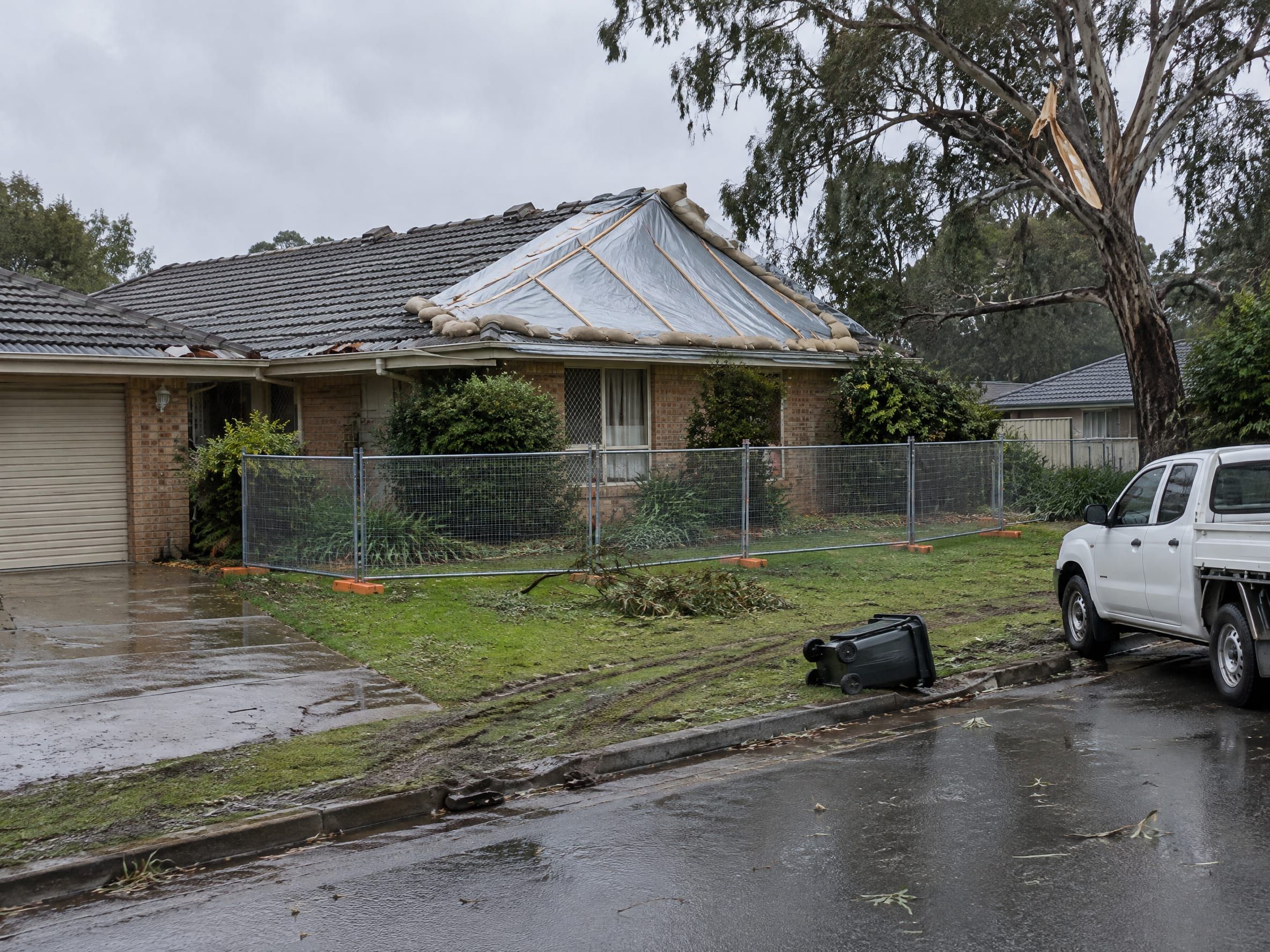
Most roof leaks start at a joint, not in the middle of a tile or sheet. Flashings, valleys, ridge lines, cracked tiles and penetrations are where water gets in, and it often travels before it shows on your ceiling. The questions that matter are where the water is entering, whether it is one failed point or a roof at the end of its life, and whether you need a make-safe now. This guide explains that decision. It is not a DIY repair guide, and we do not recommend getting onto a wet or damaged roof yourself.
Is it an emergency right now?
It is an emergency if water is coming through in volume, a ceiling is sagging or bulging, water is near light fittings or power points, or the roof has been opened up by a storm or a fallen branch. In those cases the first job is a make-safe, a temporary measure such as a tarp that stops more water getting in and makes the area safe until a permanent repair can be planned.
While you arrange it:
- Keep people out of rooms where the ceiling is sagging.
- Keep clear of water near light fittings, power points and the switchboard. The Insurance Council of Australia’s storm advice is that electricity should not be turned back on after water has entered a property until an electrician has inspected it.
- Do not climb onto a wet or storm-damaged roof.
- Photograph the damage inside and out, from the ground, before anything is moved.
For an emergency make-safe, call 0468 029 068 or see our emergency roof repairs page.
Why the ceiling stain is rarely under the leak
The stain marks where the water stopped travelling, not where it got in. Water enters high on the roof, runs along the underside of the tiles, the sarking or the battens until something interrupts it, and only then drops onto the ceiling.
Sarking is the reflective membrane under the tiles that catches water that gets past them. Battens are the timber or steel strips the tiles hang on. Both can carry water a long way sideways and downhill.
What’s The Damage’s national leak repair guide, updated November 2026, puts it plainly. The ceiling stain is where the water ends its journey, almost never where it began. The Quote Yard’s NSW roof leak guide, published September 2026, adds that the entry point can be metres away and on a different plane of the roof entirely.
That has two practical consequences.
- Patching the roof directly above the stain often misses. The repair goes in the wrong place and the next heavy rain finds the same path. What’s The Damage’s Sydney roof repair guide notes that most of the cost of a leak repair is locating the source.
- Not every wet ceiling is a roof leak. The Quote Yard guide notes that some ceiling damp is not a leak at all. Condensation in the roof space, a gutter overflowing back under the eaves or a plumbing leak in the ceiling cavity can all leave a similar stain.
Tracing a leak properly means working from the roof down, following the staining on the sarking and timbers back towards its highest point, and checking the joints above it. That is inspection work, done with safe access.
The common leak points on tile and metal roofs
Roofs leak at their interruptions. Anywhere the roof surface is cut, joined, overlapped or changes direction is a potential entry point. What’s The Damage and The Quote Yard both name flashings as the most common entry point.
Tile roofs
- Flashings. The metal strips that seal the roof where it meets a wall, chimney, skylight or vent. They lift, corrode or lose their seal.
- Valleys. The channel where two roof slopes meet. Leaves and debris build up, water spills over the edges, and older valley irons rust through.
- Ridge and hip lines. Cracked bedding, the mortar that holds the caps, or failed pointing, the flexible seal over it, lets wind-driven rain in along the top of the roof.
- Cracked or slipped tiles. Often caused by foot traffic from other trades, falling branches or storms.
- Penetrations. Vent pipes, flues, aerials, air conditioning lines and solar mounts, where the seal around the fitting has failed.
- Gutters. Blocked or undersized gutters, including box gutters, can overflow back under the roof edge and into the eaves.
Metal and COLORBOND® roofs
- Fixings. Screws that have loosened, corroded or lost their sealing washer.
- Laps. Where one sheet overlaps the next, particularly on low-pitched roofs.
- Flashings and sealant. Sealant at penetrations and flashing joints breaks down with sun and age.
- Corrosion. Sheets rusting through, often at cut edges, under trapped debris or near the coast where salt sits on the surface.
Signs it is one failed point
One failed point usually behaves consistently. It leaks in the same place, often in the same kind of weather, and the rest of the roof is sound.
Signs that point to a single repair:
- The leak appears in one spot, or only in heavy rain from one direction
- The roof has not leaked anywhere else
- An inspection finds one clear cause, such as a lifted flashing, a slipped tile, a blocked valley or one failed seal
- The tiles or sheets around it are sound and the ridge pointing is firm
What’s The Damage’s leak guide draws the line in the same place. A single leak with an identified cause is a repair. Our roof repairs page covers how those repairs are scoped and photographed.
Signs the whole roof surface is at the end of its life
A roof at the end of its surface life leaks in more than one place, and fixing one leak does not stop the next. The problem is the condition of the roof, not a single joint.
Signs that point beyond a repair:
- Leaks appearing in new places each wet season
- New repairs failing next to last year’s repairs
- Cracked or crumbling pointing along most ridges
- Concrete tiles that are porous, faded or covered in lichen across large areas
- On a metal roof, rust across many sheets and fixings failing roof-wide
What’s The Damage’s leak guide notes that repeated leaks in new spots suggest the roof surface itself is ageing, and that the economics then shift from repairing to renewing.
Whether renewing means a restoration or a replacement depends on whether the tiles or sheets are still structurally sound. Our guide to restore, repair or replace sets out the four tiers and the symptoms for each, and our roof restoration page explains the repair-first sequence.
Storm damage: make-safe, document, then wait for your insurer
If storm damage is covered by insurance, contact your insurer as soon as you can, make the roof safe from more water in the way your insurer agrees, photograph everything, and do not start permanent repairs until your insurer has authorised them. Unauthorised work may not be covered.
The Insurance Council of Australia’s advice to policyholders after the July 2022 Sydney storms and floods is specific:
- Contact your insurer as soon as possible to start the claim, even if the full extent of the damage is not yet clear.
- If you have roof damage, tell your insurer. The insurer will arrange emergency works to minimise hazards and prevent further damage, which can include isolating damaged solar panels or electrical circuits and installing a roof tarp.
- Take photos or video of the damage before the clean-up starts.
- Speak to your insurer before you attempt or authorise any building work, including emergency repairs, and ask for their permission in writing.
What’s The Damage’s storm damage and insurance guide, updated November 2026, adds that repair work beyond the make-safe should not start until the assessor has been on site. It also recommends photographing everything before and after and keeping every receipt.
Policies differ, so your insurer’s instructions come first. If your insurer asks you to arrange the make-safe yourself, get a claim number and their agreement in writing before the work starts.
We photograph the damage before and after a make-safe, so you have a record to give your insurer. Permanent repairs are a separate scope and quote, and on an insured claim they should wait for your insurer’s authorisation.
One leak or a pattern: what to do next
If you have one leak and the roof is otherwise sound, the next step is to have it traced and repaired at the point where it enters. If the leaks keep moving, or the roof shows the wider signs above, the next step is a condition inspection before anyone quotes a repair. Paying for a spot repair on a roof at the end of its surface life usually means paying for another one next season.
Either way, ask for the cause in writing and the photographs that show it. A leak inspection worth paying attention to tells you:
- Where the water is entering, or the likely entry points if the leak cannot be reproduced in dry weather
- The photographs that show it, from the roof and from the roof space where it can be reached
- Whether the cause is a single failed point or part of a wider pattern across the roof
- Whether the ceiling, insulation or timbers below have been affected
- The repair recommended, and whether it is temporary or permanent
A quote that names the entry point and the repair is one you can check. A quote that says “seal leak” is not.
Get the leak traced and checked
If water is getting in now, call 0468 029 068 for an emergency make-safe. If it is not urgent, request a free inspection.
We inspect the accessible areas of the roof, trace the leak as far as those areas allow, photograph what we find and tell you whether it is a single repair or a sign of something wider. Single leak points are handled as roof repairs. We work across the Central Coast, Lake Macquarie, Newcastle and Sydney.
Sources
- Roof Leak Repair Costs: Finding and Fixing the Drip - What's The Damage
- Roof Repair Cost Sydney - What's The Damage
- Roof Leak Repairs NSW 2026 - The Quote Yard
- Sydney extreme rain and flood insurance update (8 July 2022) - Insurance Council of Australia
- Storm Damage and Insurance: Sydney Roofing - What's The Damage
Figures quoted from third-party sources are theirs, as published at the time of writing. They are general information, not a quote or a statement about SOAKD Roof & Concrete's work.